Rooms Within Rooms: How American Women Writers Made the Miniature Domestic Space a Weapon of Literary Dissent
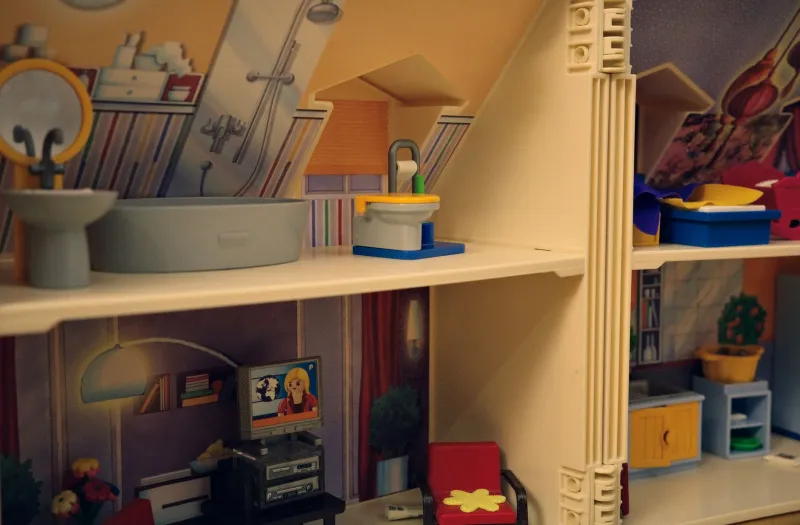
There is something deeply paradoxical about the dollhouse. Designed to miniaturize and thus to domesticate — to render the home sweet, manageable, and unthreatening — it has spent more than a century doing precisely the opposite in the hands of American women writers. In story after story, play after play, the miniature room has functioned not as a comfort but as an indictment, a scale model of the full-sized injustices that governed women's lives. To read this tradition carefully is to understand that Lilliput was never only Swift's invention. American women were building their own tiny worlds long before literary scholars thought to notice.
Glaspell's Kitchen and the Evidence Hidden in Small Things
The argument might reasonably begin in 1916, with Susan Glaspell's one-act play Trifles and its prose adaptation, "A Jury of Her Peers." In both works, two women accompany their husbands to the farmhouse of Minnie Wright, who is suspected of murdering her husband. The men, as investigators, range freely through the house, searching for significant evidence. The women remain in the kitchen — that most diminutive and feminized of domestic spaces — and find everything.
Glaspell's genius was to recognize that the miniature world of the kitchen, with its half-cleaned jars of preserves and its erratically stitched quilt squares, constituted an entire narrative that male authority was constitutionally unable to read. The men dismiss the women's observations as concern for "trifles." The women understand, through intimate familiarity with small domestic spaces, that the trifles are the testimony. The story does not merely feature a miniature world; it argues that the capacity to inhabit and interpret such worlds is itself a form of knowledge that patriarchal society has systematically devalued.
This is the foundational gesture of an entire literary tradition: the insistence that what appears small is, in fact, the whole story.
The Dollhouse as Diorama of Captivity
Ibsen's A Doll's House had already made the metaphor explicit in 1879, and American women writers absorbed that lesson with particular urgency. By the time Charlotte Perkins Gilman published "The Yellow Wallpaper" in 1892, the confined domestic interior had become a fully developed literary landscape — a miniature world in which every object carried the weight of a social argument. The room in Gilman's story is, among other things, a dollhouse gone wrong: a space designed to contain a woman that instead reveals her containment to be a form of violence.
What distinguishes the American iteration of this tradition is its persistent attention to scale. These writers were not simply criticizing domesticity in the abstract; they were mapping it, measuring its dimensions, cataloguing its objects. The miniature world demanded a cartographer's precision, and precision, in this context, became a political act. To describe the kitchen drawer, the sewing basket, the locked cabinet — to render these things in faithful detail — was to insist that they mattered, that the space women inhabited was worthy of the same serious literary attention lavished on courtrooms, battlefields, and counting houses.
Midcentury Amplifications
The tradition deepened considerably through the middle of the twentieth century. Shirley Jackson, whose Gothic sensibility was always alert to the terror latent in domestic arrangements, returned repeatedly to houses that seemed to shrink around their female inhabitants. In We Have Always Lived in the Castle (1962), Merricat Blackwood's world contracts to the dimensions of a carefully tended property — a miniature kingdom that is simultaneously a refuge and a prison. Jackson understood, as Glaspell had before her, that the miniature domestic world was not incidentally confining; it was designed to be.
Later, Grace Paley brought the miniature world down to the scale of the New York apartment, the playground bench, the kitchen table. Her stories are populated by women whose entire existences seem to unfold in a few square feet of urban space, and yet within those compressed dimensions, Paley located extraordinary moral and emotional complexity. The smallness of the setting was always, in Paley's hands, an irony: these tiny spaces contained multitudes.
Contemporary Writers and the Inherited Miniature
Contemporary American women writers have inherited this tradition and extended it in directions that would have surprised, though perhaps not astonished, their predecessors. Carmen Maria Machado's memoir In the Dream House (2019) is, among its many achievements, a sustained meditation on the way an abusive domestic relationship compressed and miniaturized the author's world. The "dream house" of the title functions precisely as a literary dollhouse: beautiful from the outside, claustrophobic within, and legible as a site of violence only to those who know how to read small spaces.
Machado's formal experimentation — the book moves through dozens of narrative modes, from Choose Your Own Adventure to fairy tale — might be understood as an attempt to break the miniature open, to find a form capacious enough to contain what the domestic space tried to suppress. In this sense, she is doing exactly what Glaspell did a century earlier: insisting that the evidence hidden in small rooms demands a larger verdict.
Elsewhere, writers like Celeste Ng have used the elaborately appointed domestic interior as a lens through which to examine race, class, and gender simultaneously. In Little Fires Everywhere (2017), the Shaker Heights homes that anchor the novel are rendered with the meticulous attention to detail that characterizes the best miniaturist fiction. Every carefully chosen object in every carefully designed room speaks to the social arrangements that the novel is quietly dismantling.
Why the Miniature Endures
It is worth asking why this tradition has proven so durable. Part of the answer lies in the particular power of the miniature as a literary device. To render a world in miniature is to make it fully visible — to step back far enough to see its architecture, its proportions, its hidden mechanisms. The dollhouse, precisely because it is small, can be examined from every angle. Nothing is obscured by proximity.
For American women writers working within and against a culture that has persistently diminished their concerns as domestic, trivial, and small, the miniature has offered a brilliant strategic reversal. If society insists that the domestic world is too small to merit serious attention, these writers have responded by taking it at its word — and then demonstrating, with devastating precision, exactly how much injustice can be packed into a very small space.
Swift built Lilliput to satirize the vanities of English political life. American women writers built their own miniature worlds to do something more urgent: to make visible the full-sized violence of the everyday. The dollhouse, in their hands, was never a toy. It was always a document.