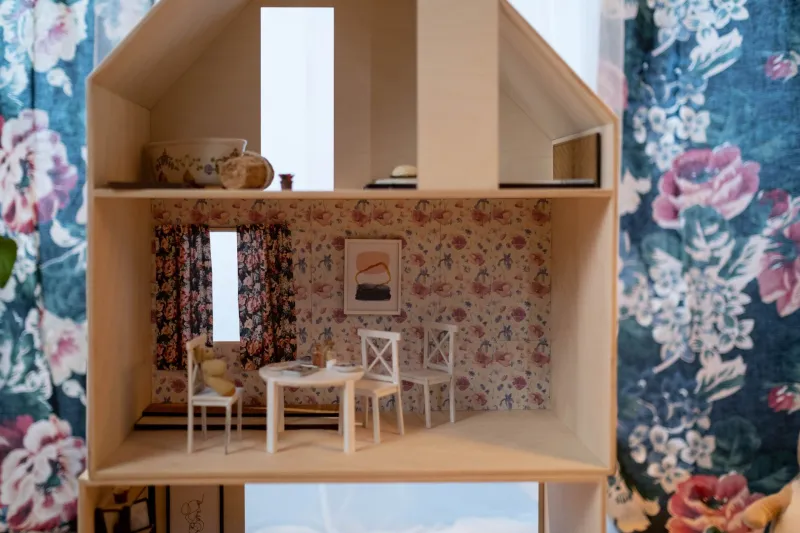
When Small Becomes Significant: How American Museums Are Dismantling the Tyranny of Scale

For most of Western cultural history, greatness has been understood as a matter of dimension. The cathedral dwarfs the worshipper. The monumental canvas overwhelms the viewer. The heroic sculpture commands the plaza. Size, in the grammar of institutional prestige, has long functioned as a proxy for seriousness — a shorthand through which museums have communicated to visitors what they are meant to revere and what they may safely overlook. But something is shifting inside America's great cultural institutions, and it is happening, fittingly, at a scale most visitors nearly walk past without noticing.
Across the country, from the Art Institute of Chicago to the Smithsonian's sprawling Washington complex, curators are devoting dedicated gallery space, acquisition budgets, and scholarly attention to the miniature arts. These are not afterthought corners tucked beside gift shops. They are considered, often architecturally distinctive spaces designed to slow visitors down, to recalibrate perception, and to argue — through the very fact of their existence — that a world rendered at one-twelfth scale can carry the same freight of meaning as anything hanging in a grand hall.
The Curatorial Argument
The case for taking miniature work seriously is not, at its core, an aesthetic one. It is an epistemological one. When curators at institutions like the Museum of Fine Arts in Boston or the Metropolitan Museum of Art in New York begin treating miniature objects as primary artifacts rather than decorative curiosities, they are implicitly challenging the criteria by which cultural value has historically been assigned.
Traditional museum hierarchies have long privileged the unique over the reproducible, the monumental over the intimate, and — critically — the publicly legible over the privately experienced. Miniature works violate all three preferences simultaneously. They are often extraordinarily labor-intensive to produce, requiring skills that dwarf those demanded by larger-scale counterparts. They reward sustained, close, individual attention rather than the sweeping collective gaze that a large painting invites from across a room. And they have historically been associated with domestic rather than civic life — with women's handiwork, with children's play, with the private interior rather than the public monument.
To elevate them, then, is to perform a kind of institutional self-criticism. It is to acknowledge that the museum's own history of exclusion — of domestic craft, of feminine labor, of the intimate and the everyday — has impoverished the story it tells about human creativity.
The Post-Pandemic Recalibration
The timing of this institutional shift is not incidental. The years following the COVID-19 pandemic forced American museums into a period of genuine self-examination that went well beyond the financial. Institutions that had long justified their authority through sheer physical grandeur — through the implicit argument that only they possessed the space to house what mattered — found themselves suddenly irrelevant to a public confined to small rooms and intimate domestic spaces.
What emerged from that period, for many curators and museum directors, was a new appreciation for the power of the small. Audiences who had spent months navigating the world at the scale of their own apartments returned to museums with recalibrated eyes. The intimate, the intricate, and the carefully observed suddenly carried an emotional resonance that the monumental struggled to match. Miniature galleries, in this context, felt not merely novel but necessary — spaces that honored the kind of attention the pandemic had, in its terrible way, cultivated.
Several institutions capitalized on this shift with notable deliberateness. The Smithsonian's National Museum of American History expanded programming around its miniature and model collections, framing them explicitly as windows into domestic history and everyday American life. Regional museums, always more attuned to local community tastes than their metropolitan counterparts, moved even faster — creating interactive miniature exhibitions designed to draw younger visitors and families who might otherwise find the traditional museum format alienating.
Gulliver in the Gallery
There is something almost literary about the experience of moving through a well-designed miniature gallery. The visitor, suddenly rendered enormous by context, must stoop, peer, and attend in ways that reverse the usual power dynamic between institution and audience. The museum, which ordinarily positions itself as the giant dispensing culture to the small visitor, becomes a space in which the visitor is the giant — and the art, tiny and intricate and sovereign in its detail, refuses to be consumed at a glance.
This is, of course, precisely the dynamic that Jonathan Swift exploited to such devastating satirical effect in Gulliver's Travels. Gulliver among the Lilliputians is not simply a man among small people; he is a perceiving subject whose relationship to scale has been catastrophically destabilized, and who must consequently question everything he thought he understood about power, proportion, and significance. American museums are, perhaps unconsciously, staging something similar. By insisting that the miniature deserves the same institutional gravity as the monumental, they are asking visitors to question whether their intuitions about size and importance can be trusted at all.
Accessibility and the Democratic Miniature
There is a further dimension to this curatorial revolution that deserves acknowledgment: the question of access. Monumental art, almost by definition, is difficult to democratize. It requires large spaces, significant infrastructure, and substantial resources to display and transport. Miniature work, paradoxically, is in some respects more portable, more reproducible in high-quality digital form, and more amenable to community-based exhibition.
Several American institutions have begun experimenting with traveling miniature exhibitions that bring serious curatorial work to smaller cities and rural communities that rarely receive attention from major museums. These exhibitions carry with them not only objects but arguments — about what art is, who makes it, and whose labor deserves to be remembered. In this sense, the miniature gallery is not merely an aesthetic proposition. It is a political one.
What Comes Next
The miniature museum revolution is still in its early chapters. Acquisition budgets remain modest compared to those devoted to painting and sculpture. Scholarly literature on miniature arts, while growing, has not yet achieved the critical mass that would make it central to art-historical curricula. And the risk of novelty — of the miniature gallery becoming a quirky institutional amenity rather than a genuine reorientation of values — remains real.
But the direction of travel is unmistakable. American museums are slowly, deliberately, and with increasing conviction learning to see what has always been there: that the smallest works in their collections have sometimes been doing the most significant imaginative labor all along. The worlds built at one-twelfth scale, it turns out, have always been full-sized in their ambitions. It simply took our institutions a very long time to bend down and look.