Architects of the Infinitesimal: Meet the Americans Building Complete Civilizations in Miniature
What follows is a curated portrait of a community, drawn from interviews, online archives, and published worldbuilding documents. All creators featured have consented to the use of their work and, where noted, their names.
A World Beneath the World
In a spare bedroom in Albuquerque, New Mexico, a retired schoolteacher named Carolyn Marsh spends her evenings drafting trade agreements. Not for any actual nation—Carolyn is not a diplomat—but for the Underveil Compact, a confederation of six subterranean societies she has been developing, alone and then collaboratively, for the better part of eleven years. The Compact has a currency (the shard, pegged to the value of polished obsidian), a system of inheritance law derived partly from Napoleonic code and partly from her own invention, and a rich oral tradition she has transcribed into more than two hundred pages of what she calls "founding myths."
No one outside her Discord server of approximately three hundred members has ever read most of it. That, she says, is entirely beside the point.
"The world needs to be real," Carolyn explains, "whether or not anyone ever visits it."
This conviction—that an imaginary civilization earns its integrity through internal consistency rather than external audience—is the animating principle of a subculture that has grown, quietly and with considerable sophistication, across the American creative landscape. Its practitioners go by various names: worldbuilders, lore architects, tabletop narrative designers. What they share is an investment in the deliberately small: micro-societies constructed with the same seriousness of purpose that a novelist might bring to a manuscript, or an urban planner to a zoning map.
The Reddit Academies
To understand how this community operates, one must spend time on Reddit, specifically in forums such as r/worldbuilding, r/magicbuilding, and the more specialized r/SpeculativeEvolution. These are not casual spaces. The posts that attract the most engagement are typically not brief sketches but extended documents: essays on the agricultural limitations of a fictional mountain civilization, annotated maps with competing territorial claims, linguistic primers for invented languages with consistent phonological rules.
Daniel Osei, a twenty-nine-year-old graphic designer based in Atlanta, has been a moderator of a mid-sized worldbuilding subreddit for four years. He describes the community's ethos with precision.
"There's a strong norm against what people call 'cool stuff without consequences,'" he says. "If you post a civilization with a powerful magic system, someone will immediately ask: what does this do to the economy? What does it do to warfare, to medicine, to social hierarchy? You have to have thought it through. The community respects craft."
Osei's own project, which he titles The Meridian Shelf, centers on a fictional archipelago whose inhabitants have developed an elaborate bureaucratic culture in response to the logistical challenges of island governance. He maintains a shared Google Drive folder containing approximately four hundred documents, ranging from census records to the collected speeches of a fictional head of state who has never appeared in any story. He has no current plans to write that story.
"The lore is the product," he says. "I'm not building toward a novel. I'm building toward a world."
Tabletop as Laboratory
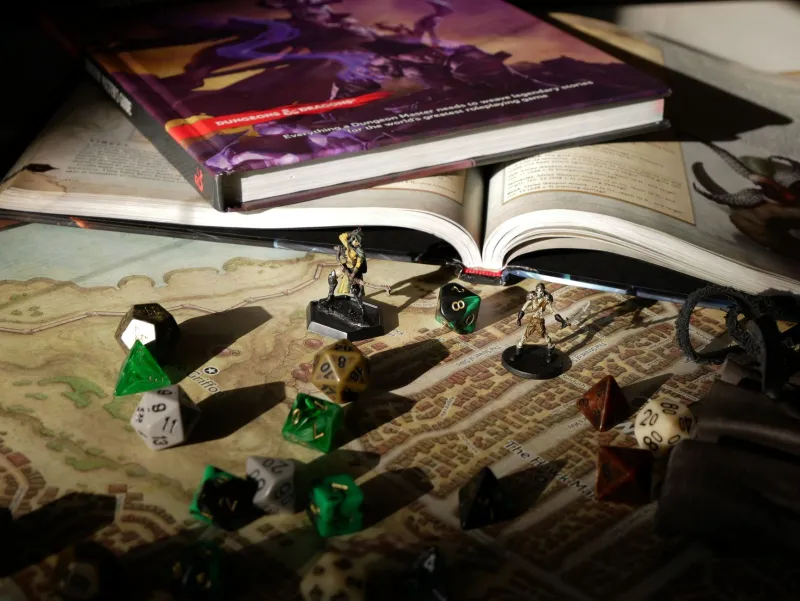
For other members of this community, the miniature civilization finds its expression not in documents but in physical and digital game design. Tabletop role-playing games—Dungeons & Dragons remains the most widely recognized, but the field has expanded enormously—provide a structural framework within which small societies can be not merely described but inhabited.
Katherine Voss, a thirty-four-year-old librarian in Minneapolis, has spent the past six years designing what she describes as a "micro-scale RPG system" intended specifically for campaigns set within a single small community rather than across a continent. Her system, called Parish, is available as a free PDF download and has been adopted by game groups in at least a dozen states, according to her download analytics.
"Most RPG systems are built for adventure at geographic scale," Voss explains. "You travel, you encounter, you defeat. Parish is built for depth rather than breadth. The campaign takes place in one village. You know every NPC. You watch the blacksmith's daughter grow up. Political factions form over whether to repair the mill."
The influence of Swift is, she acknowledges, not accidental. Voss studied eighteenth-century British literature as an undergraduate and cites Gulliver's Travels as a foundational text for her design philosophy. "Swift understood that you could examine the entire range of human political folly by making it small enough to see clearly. That's what I want Parish to do. The mill dispute is about resource allocation, factional loyalty, and intergenerational conflict. It just happens to be about a mill."
Discord and the Collaborative Turn
Perhaps the most significant development in this community over the past decade has been the migration from solitary creation to collaborative worldbuilding, facilitated primarily by Discord. Servers dedicated to shared fictional universes now operate with the organizational complexity of small nonprofits: elected lore councils, submission guidelines, canon review processes, and formal dispute resolution mechanisms for when two contributors' creations contradict each other.
One such server, which operates under the name "The Conclave of Small Nations" and has approximately eight hundred active members, maintains a fictional universe set in a world where all civilizations are constrained to territories no larger than a contemporary American county. The constraint is deliberate: it forces creators to think at the level of the local, the granular, the intimate.
The server's founding document—a two-thousand-word charter that reads, with only slight exaggeration, like a genuine constitutional text—opens with a line that would not have been out of place in a Swift preface: "We hold that a civilization's worth is not measured by the extent of its borders, but by the depth of its interior life."
What Swift Might Have Said
Jonathan Swift constructed Lilliput as an instrument of ridicule. His six-inch citizens were petty, vain, and consumed by disputes over the correct end at which to crack a boiled egg—a satire so precise in its targets that it remains legible three centuries later. Swift was not, by any conventional measure, a celebrant of miniature life. He was its prosecutor.
And yet there is something in the contemporary American worldbuilding community that Swift might have recognized, and perhaps grudgingly admired. These creators are not satirizing smallness; they are taking it seriously as a philosophical and artistic commitment. They are asking, with genuine rigor, what a society looks like when it cannot rely on the grandeur of scale to paper over its contradictions. In that sense, they are doing precisely what Swift did—examining human institutions at a resolution fine enough to reveal their actual texture.
Carolyn Marsh, drafting trade agreements for the Underveil Compact in her Albuquerque spare room, puts it simply: "Big worlds let you hide. Small worlds make you honest."
A Reading List for the Curious Builder
For those moved to explore the intellectual and creative traditions that inform this community, the following texts offer productive entry points:
- Mary Norton, The Borrowers (1952) — The foundational text for understanding how a small civilization earns narrative dignity.
- Jonathan Swift, Gulliver's Travels (1726) — Essential, not as a celebration of miniature life, but as a demonstration of what rigorous attention to scale can reveal.
- Ursula K. Le Guin, Always Coming Home (1985) — A masterwork of speculative anthropology; Le Guin constructs an entire culture, complete with poetry, recipes, and social ritual, for a fictional California valley people.
- N.K. Jemisin, The Fifth Season (2015) — A model of how a fully realized civilization can be built through implication and accumulated detail rather than direct exposition.
- Kate Beaton, Hark! A Vagrant (2011) — A reminder that the miniature tradition has a robust comedic wing, and that irreverence and rigor are not mutually exclusive.
These are not merely books to be read. In the spirit of the community they illuminate, they are blueprints—invitations to build something of one's own, however small, however complete.