Crafted Against the Current: Miniature Worlds as Quiet Acts of Cultural Defiance
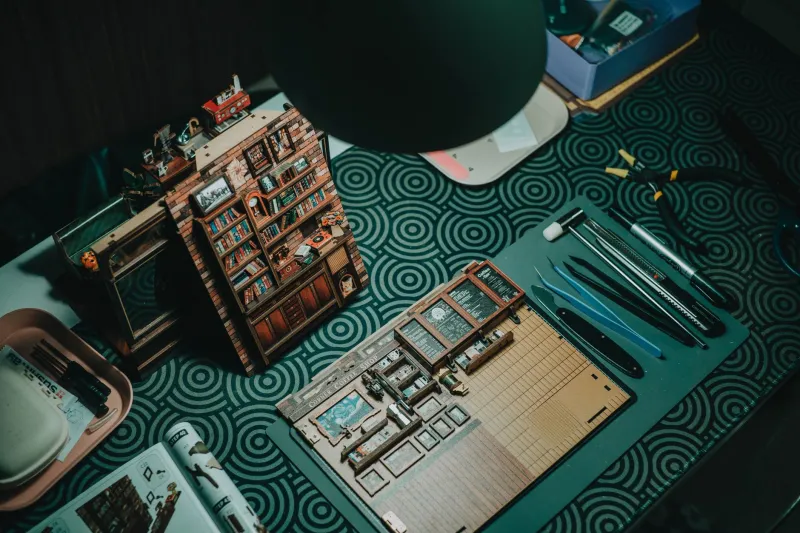
There is something almost seditious about a woman spending forty hours hand-painting the interior of a room no larger than a shoebox. In a culture that prizes velocity — next-day delivery, instant streaming, algorithmically curated everything — the deliberate, painstaking labor of miniature world-building stands as a rebuke so quiet it might be mistaken for a hobby. It is not merely a hobby. For a growing number of American artisans, it is a position.
The Philosophical Weight of the Tiny
Gulliver, when he first arrived in Lilliput, was confounded by a world that operated entirely outside the logic of his own proportions. He could not fit. He could not consume it in the way he consumed everything else. He could only observe, carefully, and reckon with what he saw. There is a useful metaphor buried in that disorientation, and contemporary miniature makers have found it.
Sarah Kellner, a Portland-based artisan who constructs Victorian-era parlors at one-twelfth scale, describes her practice in explicitly political terms. "Every piece I make is a refusal," she says. "It refuses to be manufactured somewhere I'll never see, by someone I'll never know, and shipped to me in two days wrapped in plastic I'll throw away in thirty seconds." Kellner sources her materials from estate sales, salvage yards, and independent craft suppliers. The process, she notes, is inconveniently slow. That inconvenience, she argues, is precisely the point.
This sentiment is echoed across the American miniature community with surprising consistency. What might appear, from the outside, as an eccentric pastime reveals itself, upon closer examination, as a coherent response to the homogenizing forces of contemporary consumer culture. The miniature world does not arrive pre-assembled. It does not carry a brand name. It cannot be replicated by an algorithm.
Against Algorithmic Homogeneity
The digital economy has become extraordinarily adept at predicting what we want before we know we want it. Recommendation engines surface the familiar. Social media rewards content that conforms to legible, repeatable formats. The result is a cultural landscape of startling uniformity — a vast, scrollable sameness that many Americans feel but struggle to name.
Miniature world-building resists this logic structurally. No two handcrafted dioramas are identical. No algorithm can anticipate the particular way a maker decides to weather the floorboards of a Depression-era kitchen or the precise shade of green she chooses for the moss growing between the stones of a fantasy cottage. These decisions emerge from individual sensibility, accumulated skill, and the irreducibly personal act of making something by hand. They cannot be optimized.
Marco Delgado, who builds elaborate urban streetscapes at his kitchen table in Albuquerque, describes the experience of working without digital mediation as a form of cognitive relief. "When I'm building, I'm not being tracked," he says. "Nobody is learning from what I do and selling it back to me. It's just me and the material and the problem in front of me." Delgado sells his work occasionally, through word of mouth and a deliberately minimal online presence. He is not interested in scaling up.
This rejection of scale — in both the literal and commercial sense — is one of the defining characteristics of the movement. Many of its most committed practitioners are actively suspicious of growth, of audience, of the metrics by which the digital economy measures worth. They are, in the language of Lilliput, choosing to remain small.
The Economics of Refusal
Choosing smallness carries genuine costs. The materials required for high-quality miniature work are not inexpensive. The time investment is considerable. And because the work resists mass reproduction, it rarely generates the kind of income that might justify itself by conventional economic measures.
And yet the community sustains itself. Miniature fairs — modest, unhurried affairs held in community centers and church halls across the country — draw makers and collectors who share a tacit understanding that what is being exchanged is not merely an object but a set of values. The price of a handcrafted miniature reflects not the cost of materials alone but the irreplaceable hours of a human life spent in careful, attentive labor. For both maker and buyer, that transaction carries meaning that no mass-produced equivalent can replicate.
Eleanor Marsh, who teaches miniature construction workshops in rural Vermont, frames this economy in moral terms. "When you buy something I made," she says, "you know where it came from. You know the hands that made it. That's a relationship. That's accountability. You can't say that about anything you buy from a warehouse."
Smallness as Stance
It would be easy to romanticize this. The miniature world-building community is not a political movement, and its practitioners are not, for the most part, ideologues. They are people who love what they make and find in the making a satisfaction that the broader culture increasingly fails to provide.
But satisfaction, when it is rooted in a principled rejection of prevailing norms, becomes something more than personal. It becomes an argument. The argument these makers are advancing — through their work rather than their words, through the accumulation of painstaking hours rather than the issuance of manifestos — is that the handmade, the slow, the irreducibly individual still matters. That a world built at one-twelfth scale by a single pair of hands contains more genuine meaning than any number of algorithmically generated alternatives.
Gulliver eventually left Lilliput. He could not stay — he was simply too large for that world. But he never forgot it. Its particularity lodged itself in him and refused to be dislodged. That, perhaps, is what the makers of miniature worlds are counting on. In a culture of relentless bigness, the tiny has a way of persisting.