The Rooms We Cannot Enter: What the Psychology of Miniature World-Building Reveals About the American Longing for Control
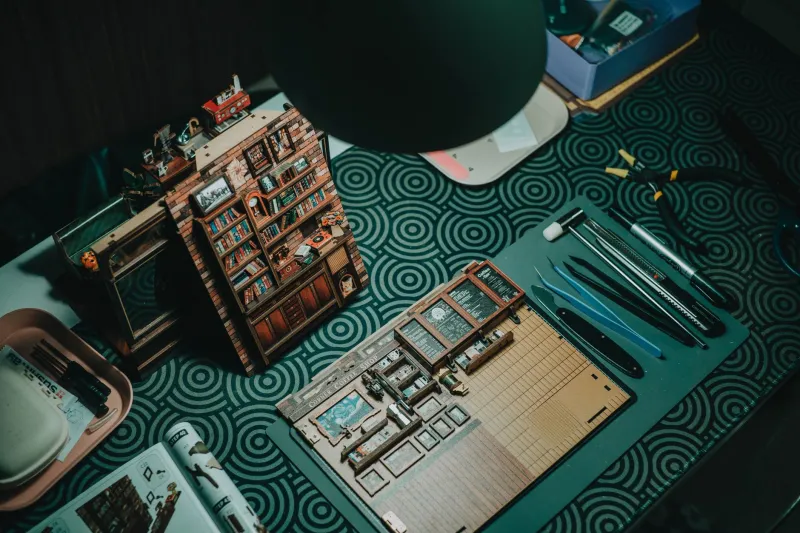
Consider the paradox at the center of the miniature world-building phenomenon. A person — let us say she is a thirty-eight-year-old accountant in Columbus, Ohio — spends her weekends constructing an exquisitely detailed 1940s library, complete with hand-painted book spines, a working brass lamp, and a Persian rug woven from thread so fine it requires magnification to appreciate. She will never sit in the chair she has upholstered. She will never read the books she has arranged on the shelves. She will never, in any physical sense, inhabit the world she has built.
And yet the satisfaction she derives from this labor is profound, persistent, and — according to researchers who study the psychology of creative practice — entirely rational.
The Neuroscience of Looking Down
The experience of viewing a miniature world activates something specific in the human brain. Dr. Alicia Norwood, a cognitive psychologist at the University of Michigan who has studied the psychological effects of scale manipulation, describes it as a form of perceptual pleasure rooted in an ancient adaptive mechanism. "When we look down on a small, bounded world," she explains, "we experience a sense of comprehension — a feeling that we can take in the whole of something. In ordinary life, that feeling is extraordinarily rare. Most of what we encounter is too large, too complex, too fast-moving to be fully grasped. The miniature offers total legibility."
This legibility, Norwood argues, triggers a neurological response associated with safety and competence. The brain, confronting a world it can fully apprehend, registers a kind of relief. The miniature is knowable in a way that reality, with its infinite complexity and indifference to human comprehension, is not.
There is, additionally, the matter of agency. The maker of a miniature world exercises a degree of control over her environment that daily life rarely affords. She decides where the furniture goes. She determines the quality of the light, the color of the walls, the season visible through the window. Nothing in the world she builds happens without her sanction. This is not a trivial pleasure. In a cultural moment defined by systemic forces that feel both enormous and ungovernable — economic precarity, environmental crisis, political turbulence — the ability to govern something completely, even something very small, carries genuine psychological weight.
Escapism and Its Discontents
The word "escapism" is often deployed dismissively, as though the desire to mentally inhabit an alternative reality were a form of weakness or evasion. Psychologists are increasingly skeptical of this framing. Dr. James Whitfield, a clinical psychologist practicing in Seattle, argues that the distinction between escapism and legitimate psychological restoration is frequently misunderstood. "Escapism implies a flight from reality," he says. "But what miniature world-building actually involves is a return to a manageable version of reality — one in which the self is competent, the environment is responsive, and the outcomes of effort are visible and satisfying. That's not escape. That's repair."
The miniature world, in this reading, is not an alternative to lived experience but a laboratory for rehearsing the emotional conditions that make lived experience bearable. When we arrange a tiny kitchen and imagine the family that might gather there, we are not retreating from our own families and kitchens. We are, in some sense, practicing the feelings we wish those spaces could reliably generate.
This distinction matters particularly for American makers, who operate within a cultural context that is simultaneously deeply nostalgic and profoundly anxious about the future. The miniature worlds that Americans build are frequently historical — Victorian parlors, mid-century diners, Depression-era farmhouses. They are, in effect, three-dimensional acts of memory, spaces in which a more legible version of American life can be preserved and revisited.
Belonging at One-Twelfth Scale
Beyond control and comprehension, the psychology of miniature world-building is also, fundamentally, a psychology of belonging. The worlds people build are almost always inhabited — by figures, by implied presences, by the suggestion of domestic life in progress. The half-eaten meal on the miniature table. The open book on the miniature chair. The coat hung by the miniature door.
These details are not accidental. They are the traces of an imagined occupant with whom the maker has established a relationship of identification. In building a world for someone who does not exist, the maker is, in some measure, building a world for herself — a world in which she would know where everything is, where the light falls predictably, where the scale of things is calibrated to her authority rather than her smallness.
"There's a reason people almost always build inhabited worlds rather than empty ones," observes Dr. Norwood. "The presence of an implied life — even a fictional one — activates our social cognition. We read the space as a narrative. We imagine the person who lives there. And in doing so, we experience a form of social connection that is, paradoxically, entirely within our control."
The Gulliver Inversion
In Swift's original novel, Gulliver's distress in Lilliput arises partly from the experience of being seen — of being the spectacle rather than the spectator, the object of scrutiny rather than its subject. The miniature world-builder experiences precisely the inverse condition. She is always the observer. She is always larger. She is always, in the most literal possible sense, above it all.
This inversion is not incidental. It is, many practitioners suggest, among the most significant pleasures the form affords. In a world that frequently makes us feel small — professionally, economically, existentially — the miniature offers a reliable reversal of that condition. Here, we are the giants. Here, we are the ones who determine the shape of things.
That this reversal is achieved through an object we cannot enter, a world we cannot touch without risking its destruction, adds a layer of poignancy that the most thoughtful makers acknowledge freely. The world we build is also, in some sense, a world we cannot have. And perhaps that, too, is part of its power — the way it holds our longing at exactly the right distance, close enough to feel, small enough to keep.