Fiction at One-Twelfth Scale: The American Novelists Turning Dollhouses Into Complete Literary Universes
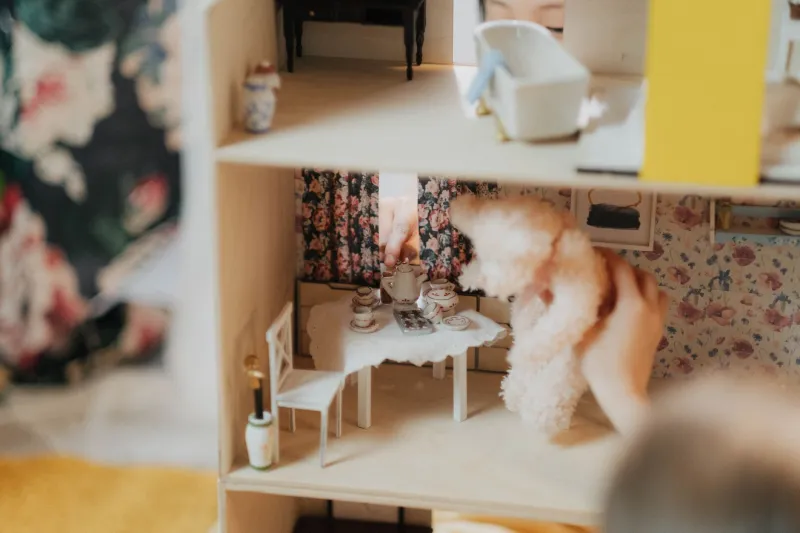
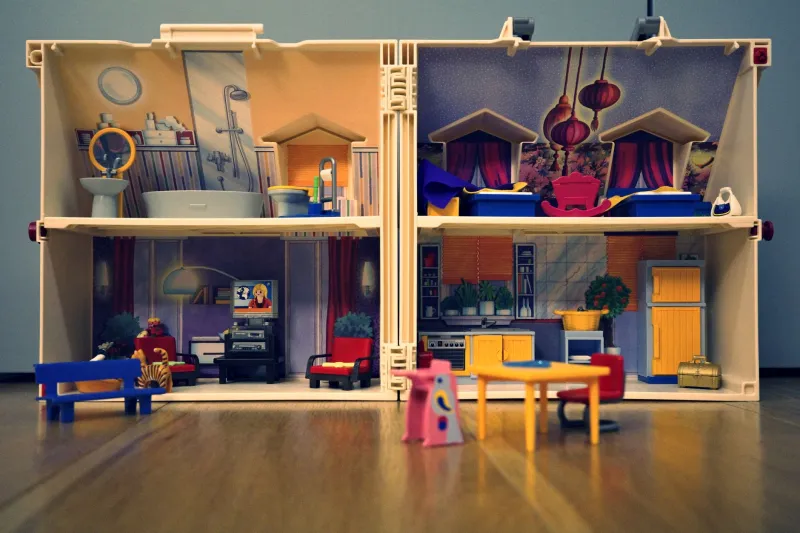
There is a peculiar discipline required to write a novel whose entire action unfolds within four hundred square inches of painted balsa wood and hand-stitched carpet. Every doorway must be negotiated. Every staircase is a dramatic event. The kitchen, perpetually lit by a fixed electric bulb no larger than a pea, becomes the emotional center of gravity for every character who passes through it. This is the condition that a small but increasingly visible group of American fiction writers has chosen — voluntarily, even joyfully — to impose upon themselves.
They are, informally, being called the Dollhouse Novelists.
A Genre Assembles Itself
The designation is imprecise, as all useful literary labels tend to be. The writers who fall under its loose canopy do not share a manifesto or a publishing house. What they share is a commitment to treating miniature architectural spaces — dollhouses most commonly, but also model train layouts, architectural maquettes, and hand-built room boxes — as the complete and non-metaphorical settings of serious literary fiction. The miniature space is not a symbol of something larger. It simply is the world of the story.
Miranda Osei, whose debut novel The Parlor at the End of the Hall (Fenwick & Cross, 2023) unfolds entirely within a twelve-room Victorian dollhouse inherited by a recently widowed woman in rural Vermont, has described the constraint as clarifying rather than limiting. "When your character cannot leave the building — not because she is imprisoned, but because the building is the whole of existence — you are forced to locate drama in the granular," Osei said in a recent interview with a literary podcast. "A drawer that sticks. A window that does not open the way it used to. These become the load-bearing walls of the plot."
Osei's novel was reviewed favorably in several mid-sized literary journals, with one critic noting that it achieved "the unsettling intimacy of a Cheever story compressed into a space where the characters cannot even pretend to escape each other."
The Constraint That Liberates
The creative logic underlying this trend is not without precedent. Formal constraint has long been recognized as a generative force in literature — the sonnet's fourteen lines, the short story's insistence on compression, the epistolary novel's confinement to correspondence. What the Dollhouse Novelists are doing is applying a spatial equivalent of that pressure.
Denver-based author Caleb Pruitt, whose story collection Small Hours (Meridian Press, 2022) comprises eleven stories each set in a different room of a single model craftsman bungalow, describes the process as one of radical prioritization. "You cannot have a car chase. You cannot have a landscape," he said. "What you have is a marriage happening in a kitchen the size of a paperback novel. You have a father and a son in a bathroom where there is nowhere to look except at each other. The space does the work of forcing intimacy that a writer in a conventional setting has to manufacture through other means."
Pruitt's collection has found a devoted readership among short fiction enthusiasts, and its structural conceit — each story annotated with a hand-drawn floor plan of the room in which it takes place — has attracted particular attention from editors interested in the intersection of visual art and literary form.
What Editors Are Watching
Naomi Tessler, a senior acquisitions editor at a New York independent press that has published two works in this emerging vein, has been tracking the trend with considerable interest. "What strikes me about the manuscripts I've been seeing in this space is that writers are not using the miniature as a cute gimmick," she observed. "They are using it as a pressure cooker. The dollhouse, the model room — these are spaces that American culture has long associated with control, with idealization, with the fantasy of a home that behaves exactly as it is supposed to. When you put complicated, flawed human beings into that space and refuse to let them leave, you get a very particular kind of friction."
That friction, Tessler argues, is doing genuine literary work. "We are living through a moment when the American home is freighted with enormous anxiety — economic anxiety, domestic anxiety, questions about who belongs where and under what conditions. Fiction that literalizes that by placing characters in a space they cannot exit is responding to something real in the culture."
Literary critic and essayist Dorothea Vance, who recently published a long-form piece examining the trend for a Chicago-based quarterly, concurs. "Swift understood that scale is never innocent," she wrote. "To miniaturize something is to assert a relationship of power over it. The Dollhouse Novelists are interrogating that relationship from the inside. Their characters live in spaces that were designed to be looked at, controlled, perfected — and they are refusing to behave."
The Model Train Exception
Not all work in this genre confines itself to domestic architecture. A notable outlier is the novelist Josephine Achebe-Marsh, whose forthcoming work The Gauge is set entirely within a model train layout — a fictional HO-scale railroad empire spanning a twelve-by-eight-foot table in a retired engineer's basement in suburban Ohio. The novel follows four characters who inhabit the miniature towns along the layout's route, aware that they exist within a constructed world but uncertain of its maker's intentions.
Achebe-Marsh has described The Gauge as part Calvino, part Thornton Wilder, and part meditation on American infrastructure nostalgia. "Model railroading is a very particular American obsession," she noted. "It is about mastery and memory simultaneously. My characters live inside someone else's nostalgia. That seems to me a very American condition."
A Serious Genre in Formation
Whether the Dollhouse Novelists will cohere into a recognized literary movement or disperse into the broader landscape of experimental fiction remains an open question. What is clear is that their work is being read with genuine seriousness by critics and editors who might, a decade ago, have dismissed the premise as whimsical.
The miniature space, it turns out, is large enough to contain a great deal. It holds marriages in collapse and families in negotiation. It holds the American fantasy of the perfect home and the American reality of what homes actually cost — emotionally, financially, psychologically. It holds, in its hand-painted walls and its fixed electric light, something that feels very much like truth at close range.
For readers accustomed to the vast, roving canvases of the great American novel — the cross-country road trip, the generational saga, the panoramic social portrait — fiction at one-twelfth scale may require an adjustment of expectations. But those willing to lean in, to press their eye close to the tiny window and look, may find that the view is unexpectedly expansive.