Sovereign Over the Small: What America's Miniature World Obsession Reveals About the Limits of Bigness
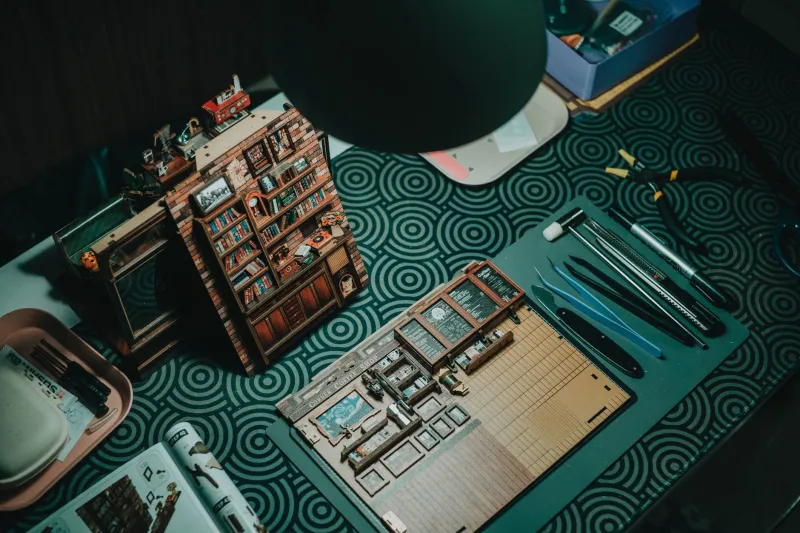
In the tradition of Jonathan Swift's Lilliput—that island nation where the tiniest details carried the weightiest consequences—Americans have long understood, somewhere beneath the surface of their ambitions, that scale alone does not confer meaning. Yet for most of the twentieth century, the national imagination ran in precisely the opposite direction: bigger houses, wider highways, larger portions, grander claims. To possess more square footage was to possess more of life itself.
Something has shifted. Quietly, persistently, and with a kind of deliberate intentionality that defies easy categorization, a growing number of Americans—many of them comfortably affluent, many of them accomplished professionals—are choosing to inhabit smaller physical spaces while investing thousands of dollars and hundreds of hours in the construction of miniature worlds of extraordinary complexity. The phenomenon is not merely a hobbyist curiosity. It is a cultural signal worth decoding.
The Arithmetic of Downsizing
The numbers, taken in isolation, appear paradoxical. The average American single-family home has grown by more than one thousand square feet since the 1970s, even as average household size has declined. And yet real estate analysts in cities from Portland to Nashville report a measurable uptick in voluntary downsizing among buyers who could afford more space but have elected not to pursue it. Meanwhile, the miniature crafting industry—encompassing everything from architectural dollhouse kits to museum-quality dioramas—has expanded into a market that industry observers estimate conservatively in the hundreds of millions of dollars annually.
These two trajectories are not coincidental. They share a common origin in the exhaustion that maximalism eventually produces.
Consider what it means to maintain a four-thousand-square-foot home in suburban America: the cleaning, the heating, the furniture to fill corners that serve no authentic human purpose, the psychological weight of rooms that exist primarily to demonstrate prosperity. The philosopher Gaston Bachelard, writing in The Poetics of Space, observed that intimate spaces invite a different quality of attention than grand ones—a more concentrated, more personal form of habitation. Americans appear to be rediscovering this truth through the unlikely medium of one-twelfth-scale Victorian parlors and hand-painted fairy-tale dioramas.
Control as Creative Act
There is something else operating here beyond mere fatigue with square footage. The miniature world offers its creator something the contemporary American environment conspicuously withholds: sovereignty. In a period defined by algorithmic uncertainty, institutional dysfunction, and the disorienting pace of technological change, the ability to determine every variable of an environment—the placement of a half-inch bookcase, the color of a thumb-sized rug, the particular quality of light admitted through a window smaller than a playing card—represents a form of agency that ordinary life rarely provides.
This is not escapism in any pejorative sense. It is, rather, what psychologists who study restorative environments describe as a return to what the researcher Rachel Kaplan termed "soft fascination": a mode of engaged attention that replenishes cognitive resources depleted by the demands of contemporary existence. The miniature world is, in this reading, less a retreat from reality than a laboratory for reasserting one's capacity to shape it.
The Lilliputian imagination has always understood this dynamic. Swift's Gulliver, towering over an entire civilization, was paradoxically rendered powerless by his scale—immobilized by threads he could have snapped with a breath. The creators of contemporary miniature worlds have inverted this logic: by assuming the role of the giant who arranges rather than the giant who dominates, they discover a form of power that is generative rather than coercive.
Rebellion in Miniature
To characterize this trend as mere rebellion against consumer culture risks oversimplification, but the oppositional dimension is real and worth acknowledging. American maximalism has always carried within it the seeds of its own critique. The McMansion, that peculiarly American architectural form, has attracted sustained mockery precisely because its scale so often exceeds its substance—rooms that impress without nourishing, facades that signal wealth without encoding memory or meaning.
The miniaturist, by contrast, operates under conditions of productive constraint. Every square inch must justify its existence. Every object must be chosen, crafted, or sourced with deliberate intention. The result is an environment in which density of meaning compensates entirely for smallness of scale—and frequently surpasses, in expressive richness, the interiors of homes twenty times its size.
This is the theorem of tiny spaces: that limitation, properly embraced, does not diminish creative possibility but concentrates it. The poet works within the sonnet's fourteen lines; the miniaturist works within the dollhouse's twelve inches of height. Both discover that constraint is not the enemy of imagination but its most reliable collaborator.
What Lilliput Knew
Retell Lilliput has long argued that Swift's fictional island nation was never merely a satirical device. It was a thought experiment about what happens when a civilization is forced to reckon with its own proportions—when the question of how much space a society occupies becomes inseparable from the question of what that society values.
Americans investing in miniature worlds are conducting a version of that same reckoning. They are asking, in the most tactile and immediate way available to them, what an environment looks like when it contains only what is genuinely cherished. The answer, it turns out, is often astonishing in its detail, its warmth, and its coherence.
If the supersized American dream is beginning to feel like a house too large to heat, perhaps the corrective was always going to be found somewhere very small indeed—in a room no larger than a shoebox, furnished with the patient devotion that grand spaces rarely inspire.
The theorem holds. Sovereignty scales downward beautifully.