What We Keep at One-Twelfth Scale: Miniature Worlds and the Architecture of Grief

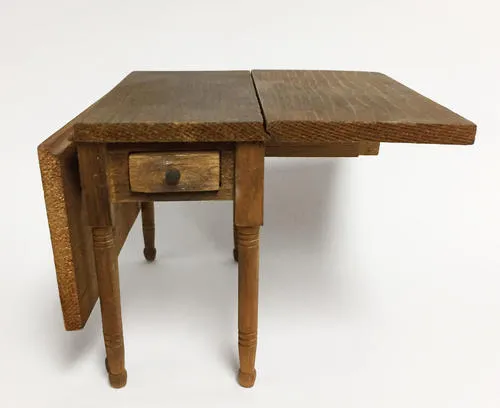
Photo: Dietmar Rabich, CC BY-SA 4.0, via Wikimedia Commons
The house no longer exists. It was demolished in 2019 to make way for a mixed-use development in a mid-sized Midwestern city—one of thousands of ordinary American demolitions that generate a few lines in a local planning commission report and then disappear from the public record entirely. But inside a spare bedroom in suburban Ohio, it still stands. Every room is intact. The kitchen linoleum, a pattern of faded yellow diamonds, has been faithfully reproduced at one-twelfth scale. The back porch, where three generations of a family gathered on summer evenings, extends from the rear of the structure at precisely the angle it held for ninety years.
The woman who built it spent fourteen months on the project. She describes it not as a hobby but as a necessity.
This is the landscape of miniature grief: an intimate, largely undiscussed practice that is quietly proliferating across the country, drawing in people who have discovered, often by accident, that the act of meticulous small-scale reconstruction offers something that conventional mourning does not. It offers control. It offers duration. It offers, above all, the particular quality of attention that grief demands but ordinary life rarely permits.
The Literature of Small Losses
For readers who have spent time with the literature of loss—from Joan Didion's The Year of Magical Thinking to Cheryl Strayed's Wild, from C.S. Lewis's A Grief Observed to the quiet devastations of Mary Oliver's late poetry—the impulse to reconstruct what has been lost in physical form will feel familiar. Writers have always understood that grief is not merely an emotional state but a spatial one: it is the experience of moving through a world from which something essential has been removed, and feeling the absence as a kind of structural damage.
What the miniature form offers is the inverse of that damage. It is the reconstruction of the structure—not at full scale, which would be impossible, but at a scale that is manageable, containable, and entirely subject to the maker's authority. The miniature world cannot restore what has been lost. But it can create a space in which the lost thing persists, subject to the maker's ongoing attention and care.
Therapists who work with grieving clients have begun to take note of this phenomenon, and several have started incorporating miniature-making into their practice. The reasons they cite are consistent. The practice is slow enough to allow the emotional content of grief to surface without being overwhelming. It is tactile in a way that talk therapy is not, engaging the hands and the body in a process that can reach experiences that language struggles to access. And it is generative: it produces something that continues to exist after the session ends, a physical object that can be returned to, amended, and elaborated over time.
This last quality may be the most significant. Grief, as anyone who has experienced serious loss will attest, is not a process with a clear endpoint. It is a relationship with absence that evolves over years and decades. The miniature world, which can always receive another detail, another room, another carefully rendered object, is structurally suited to that kind of long-term engagement.
Extinct Things and the Scale of Memory
Not all miniature grief is directed at human loss. A striking number of practitioners are building worlds organized around other categories of disappearance: demolished buildings and vanished neighborhoods, extinct species, discontinued products, obsolete technologies, and cultural practices that have been lost to time or economic pressure.
This breadth is itself revealing. It suggests that the miniature grief practice is responding to something larger than individual bereavement—to a pervasive cultural experience of loss that is rarely named as such but is felt widely, particularly in communities that have experienced rapid economic or demographic change.
The corner drugstore that was replaced by a national chain pharmacy. The independent movie theater that became a parking garage. The regional dialect that the children no longer speak. These are not the losses that generate sympathy cards or casseroles. But they are real losses, and they accumulate in the bodies and memories of the people who carry them in ways that have few legitimate outlets.
The miniature world provides one. It says, in the most concrete possible terms: this existed, it mattered, and someone cared enough to remember it in detail.
Recommended Reading for the Miniature Mourner
For those drawn to explore this intersection of grief, memory, and small-scale making through literature, a curated selection of works offers particular resonance.
Marilynne Robinson's Gilead offers perhaps the most sustained literary meditation on the relationship between memory, mortality, and the objects through which we attempt to hold what is passing. Its narrator's meticulous attention to the textures of ordinary life reads, in this context, as a form of miniature-making in prose.
Italo Calvino's Invisible Cities constructs an entire architecture of loss through Marco Polo's descriptions of cities that exist only in the imagination—worlds built from memory and desire, each one a meditation on the impossibility of recovering what has been left behind.
Elizabeth Bishop's Complete Poems returns repeatedly to the experience of loss at intimate scale. Her poem "One Art" in particular—with its catalogue of losses that escalates from door keys to continents—captures the way grief operates across registers, finding the monumental in the miniature and the miniature in the monumental.
Toni Morrison's Beloved engages with the most extreme form of this practice: the attempt to reconstruct and inhabit a past so painful that it resists direct approach. The novel's understanding of haunting as a form of unfinished grieving speaks directly to the impulse that drives miniature memorialization.
W.G. Sebald's The Rings of Saturn moves through a landscape of ruin and disappearance with a quality of attention that mirrors the miniature maker's discipline—finding in small, overlooked details the evidence of vast historical losses.
The Ethics of Reconstruction
There is a question worth raising carefully, and it is one that practitioners themselves often raise: what does it mean to reconstruct a lost world in miniature? Is it an act of preservation or of possession? Does it honor the lost thing, or does it domesticate it—render it manageable in ways that its full-scale reality never was?
These are not questions with clean answers. But they are the right questions to ask, and the fact that serious practitioners are asking them suggests that miniature grief, at its most thoughtful, is not merely a coping mechanism. It is a form of ethical engagement with loss—an insistence that what has disappeared deserves to be remembered with care, with accuracy, and with the kind of sustained attention that grief, at its best, demands.
In Gulliver's Travels, the protagonist returns from his voyages changed by his encounters with worlds at different scales. He has learned, through the disorientation of smallness and largeness, to see his own world differently. The miniature grievers building their scaled-down memorials are engaged in a similar reorientation. They are learning, through the discipline of reconstruction, to see what they have lost with a clarity that full scale never permitted. And in that clarity, however painful, there is something that resembles, at least provisionally, peace.