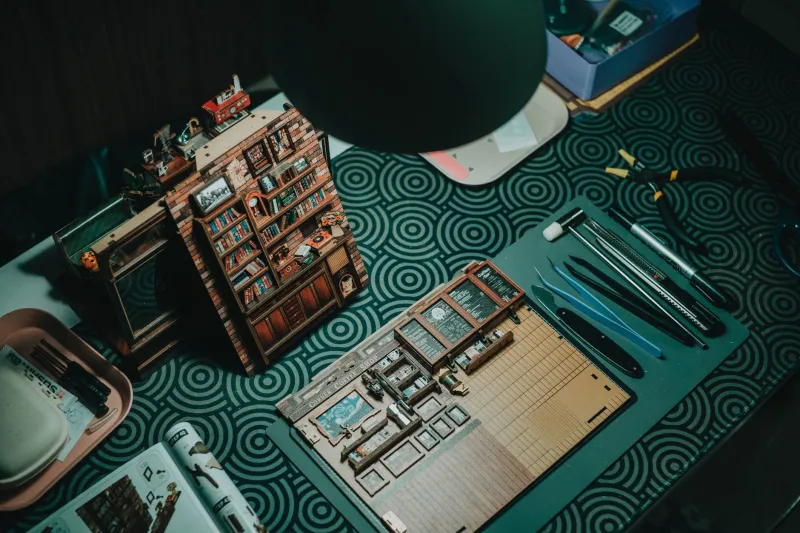
Finding Your Fellow Borrower: The Miniature World Enthusiasts Building Romance One Tiny Brick at a Time
Photo: Wayne National Forest, CC BY 2.0, via Wikimedia Commons
Most first dates involve some version of the same negotiation: two people attempting to determine, through careful conversational excavation, whether their inner lives are compatible. The process is imprecise and often exhausting. What if, instead, you could simply show someone a one-twelfth scale rendering of a Victorian apothecary you had spent three years constructing by hand, and know within moments whether they were your person?
For a growing community of miniature world enthusiasts across the United States, something close to that scenario has become a genuine possibility. In niche online spaces — dedicated forums, specialty subreddits, Discord servers organized around specific scales and genres, and increasingly, mainstream dating platforms where miniature-making features prominently in profile descriptions — collectors, builders, and imaginative hobbyists are finding not only creative community but lasting romantic partnership.
The phenomenon is more culturally significant than its whimsical surface might suggest.
The Grammar of a Shared Obsession
To understand why miniature world enthusiasm functions so effectively as romantic common ground, it helps to understand what the hobby actually demands of its practitioners. Building a convincing miniature world — whether a dollhouse interior, a fantasy diorama, or a scale-model street scene — requires patience, precision, aesthetic sensibility, narrative imagination, and a willingness to invest enormous effort in something that offers no practical return whatsoever. These are not incidental qualities. They are, as anyone who has encountered them in a partner will attest, rather rare ones.
When two people who share this particular combination of traits find each other, the resulting connection tends to be unusually deep. They speak the same technical language — the names of adhesives and scale ratios and miniature furniture makers — but more importantly, they share the same imaginative grammar. They both understand, instinctively, why it matters that the books on the miniature library shelf have legible spines. They both feel the particular satisfaction of a scene that is not merely accurate but alive.
This is the territory that the literary tradition has always recognized as the foundation of genuine intimacy: not the sharing of preferences, but the sharing of a way of perceiving.
Platforms, Communities, and the Art of the Reveal
The communities through which miniature enthusiasts find one another vary considerably in their structure and formality. Some are organized around specific scales or genres — the one-inch-to-one-foot devotees, the historical miniaturists, the fantasy and science fiction world-builders. Others are broader creative communities in which miniature-making is one of several shared interests.
What nearly all of them share is a culture of what longtime participants describe as "the reveal" — the moment when a work in progress is shared with the community for the first time. In these moments, the emotional stakes are surprisingly high. A miniature world is, almost by definition, an act of self-disclosure. The scenes people choose to build, the stories they embed in the arrangement of tiny objects, the aesthetic choices they make about color and texture and period detail — all of these communicate something about the builder's inner life that conventional social interaction rarely surfaces.
For people who have found romantic partners through these communities, the reveal is frequently described as the turning point. Not because the work was technically impressive, but because seeing it told them something essential about who had made it.
What Tiny Worlds Say About Their Builders
The connection between miniature world-building and self-expression has a long literary precedent. From the intricate cabinet curiosities of seventeenth-century Europe to the painstakingly furnished dollhouses that Virginia Woolf and her contemporaries found so philosophically suggestive, the miniature has always functioned as a kind of concentrated autobiography. What we choose to render small — and how we render it — reveals the contours of our imagination with unusual clarity.
This is perhaps why romantic connections forged in miniature communities tend, by the accounts of participants, to move quickly toward depth. The preliminary work of self-disclosure has, in a sense, already been accomplished. By the time two enthusiasts begin a direct conversation, they have often already seen each other's creative work — and creative work, in this context, is not a portfolio. It is a window.
Couples who met through miniature communities frequently describe a quality of recognition in their early interactions that they find difficult to articulate in conventional terms. The sense of having been, somehow, already known.
The Broader Question of Creative Kinship
Beyond romance, these communities perform another function that deserves acknowledgment: they provide a form of belonging that is genuinely difficult to find elsewhere. The miniature world enthusiast occupies a curious position in American social life — passionate about something that mainstream culture regards with benign incomprehension at best, mild condescension at worst. To find people who not only understand the passion but share it is, for many, a transformative experience.
This, too, echoes a theme that runs through the literature of small worlds. Swift's Lilliputians were not diminished by their scale; they were, within their own civilization, fully realized. The miniature enthusiast communities of contemporary America operate on a similar principle. Inside their forums and Discord servers and convention halls, what might appear marginal from the outside reveals itself, on closer inspection, to be rich, complex, and self-sustaining.
Gulliver was always most interesting not when he towered over Lilliput, but when he began, however reluctantly, to take its inhabitants seriously on their own terms. The Americans building love stories around shared miniature worlds are engaged in something not entirely different: the recognition that scale is no measure of significance, and that the worlds worth inhabiting — whether in glass cases or in life — are often the ones small enough to see whole.