Glass Cases and Civic Grace: The Small-Town Diorama Keepers Rescuing America's Vanishing Main Streets
Glass Cases and Civic Grace: The Small-Town Diorama Keepers Rescuing America's Vanishing Main Streets
There is a particular kind of grief that belongs exclusively to small towns — the grief of watching a familiar corner become a parking lot, of seeing the hardware store your grandfather frequented replaced by a chain pharmacy that carries no memory of what stood before it. It is a grief without formal rites, unacknowledged by the broader culture, and yet it accumulates quietly in the people who remain. In dozens of communities across rural and small-town America, a scattered but earnest movement of amateur historians, retired schoolteachers, and devoted community volunteers has found an answer to this grief in an unlikely medium: the miniature diorama.
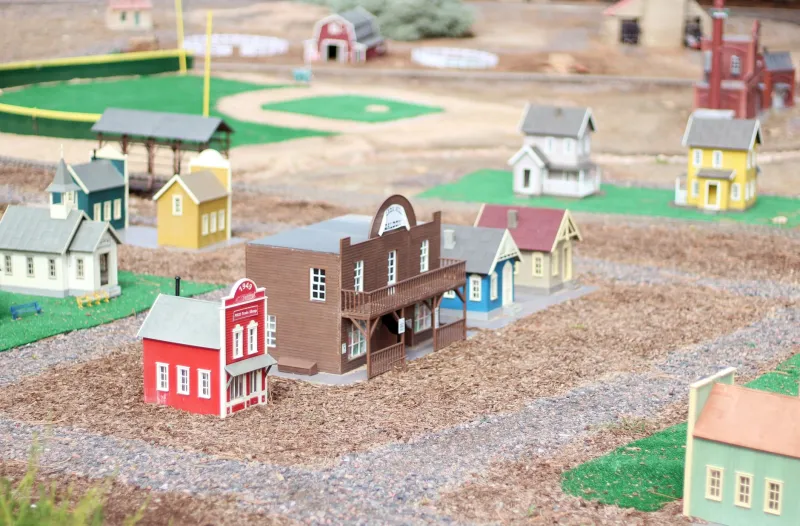
These are not the crude shoeboxes of elementary school science projects. They are intricate, obsessively detailed reconstructions of vanished Main Streets, demolished courthouses, and long-gone town squares, built at scales ranging from one-twelfth to one-twenty-fourth of life size, and housed most often in the lobbies of local libraries, the back rooms of historical societies, or the modest galleries of community museums. They are, in the truest sense, Lilliputian acts of love — and they deserve far more attention than they typically receive.
The Impulse to Preserve Through Reduction
When Jonathan Swift sent Lemuel Gulliver to the shores of Lilliput, he understood something essential about the human relationship to scale: that to reduce a thing is not necessarily to diminish it. Sometimes, to shrink a world is to clarify it, to hold it still long enough to truly see it. The diorama builders of small-town America appear to have arrived at this same understanding through entirely different means — not through satire, but through sorrow and stubborn civic pride.
Consider the work of the volunteers at the Calhoun County Historical Society in rural Michigan, who spent three years constructing a one-twelfth-scale replica of their county seat's downtown district as it appeared in 1952. Every storefront along that vanished commercial corridor has been painstakingly recreated: the five-and-dime with its hand-lettered window signs, the barbershop with its striped pole and two waiting chairs, the movie theater whose marquee still advertises a film that played seventy years ago. The builders sourced period photographs from family albums, cross-referenced newspaper advertisements, and consulted the memories of elderly residents to ensure that no detail was invented where a true one could be recovered.
The result is not simply a model. It is a form of testimony.
Memory as Architecture
What distinguishes these projects from conventional historical preservation — the restoration of a single landmark, say, or the digitization of a newspaper archive — is their insistence on the spatial and the relational. A diorama does not preserve a building in isolation; it preserves an entire ecology of place. The pharmacy exists in proportion to the hardware store next door. The distance between the church and the tavern is to scale. The angle at which the afternoon light fell across the street is, in the best of these works, suggested by the careful placement of miniature awnings and the deliberate coloring of tiny sidewalk surfaces.
This spatial fidelity matters because human memory is itself spatial. We do not remember our hometowns as lists of facts; we remember them as walks, as distances, as the particular quality of a corner. The miniature diorama honors this architecture of recollection in a way that a photograph or a written history simply cannot.
In Harlan, Iowa, a retired postal worker named Gerald Fenwick spent eleven years constructing a diorama of his town's central square as it appeared during the 1940s. He built it not from a single photograph but from hundreds, assembling a composite memory that no single image could have captured. When the finished piece was installed at the Shelby County Historical Society, elderly residents gathered around the glass case and began pointing — at the dry goods store where their mothers shopped, at the corner where they had waited for the school bus, at the alley where they had kissed someone for the first time. The diorama had not merely preserved a place. It had unlocked a generation of private memory.
The Politics of the Miniature Record
There is, it must be acknowledged, a political dimension to these projects that their creators do not always articulate but that is nonetheless present. The towns being preserved in miniature are, in many cases, towns that larger economic and cultural forces have chosen to forget. The closure of rural hospitals, the consolidation of school districts, the departure of manufacturing employers — these are not abstract policy questions to the people building these dioramas. They are the conditions that make preservation urgent.
To reconstruct a vanishing Main Street in miniature is, in this sense, an act of quiet resistance. It insists that this place mattered, that the lives lived here were worth recording, that the particular texture of this community — its storefronts, its rhythms, its unwritten social geography — constitutes a form of American experience that deserves commemoration alongside the grand monuments of the nation's official history.
The miniature form is, paradoxically, well suited to this political weight. There is something about the act of reduction that strips away pretension and forces attention to the essential. A great national monument imposes awe through scale; a miniature diorama earns reverence through precision. Every hand-painted brick, every tiny curtain sewn from period fabric, every minuscule newspaper folded and placed on a doorstep represents hours of human attention directed at a place that the wider world has largely ceased to notice.
What the Glass Case Contains
Standing before one of these dioramas — really standing before it, giving it the time it demands — produces a peculiar emotional effect that is difficult to name precisely. It is something between nostalgia and elegy, between wonder and mourning. The world inside the glass case is complete and still and utterly unreachable, and that unreachability is the point. These are not places one can visit. They are places one can only witness.
In this, the small-town diorama tradition shares something profound with the imaginative project that has always animated the literature of miniature worlds. Swift's Lilliput, Mary Norton's Borrowers, Stuart Little's improbable adventures among human furniture — all of these narratives derive their power from the same source: the recognition that a world made small is a world made visible in ways that ordinary scale obscures. The diorama builders of rural America may not think of themselves as literary figures, but they are engaged in a deeply imaginative act, one that transforms the raw material of local history into something closer to myth.
America has always been a nation that tells itself stories about its own vastness — its open roads, its endless horizons, its continental ambitions. The miniature diorama offers a necessary counternarrative: that some of the most significant American stories are small ones, that the measure of a civilization is not only its grandest monuments but also the particular way afternoon light fell on a particular corner of a particular street in a town that most of the country has never heard of.
The people building these glass-encased worlds understand this. They are, in their quiet and meticulous way, doing something that no digital archive and no official historical commission has managed to do: they are making the vanishing visible, one tiny room at a time.