Secret Tenants: The American Makers Hiding Entire Civilizations Inside Their Own Walls
There is a particular kind of attention that a person brings to a baseboard once they have begun to suspect it might be inhabited. The painted wood, the thin gap where the molding meets the floor, the faint darkness beyond — none of these things look quite the same after the imagination has been invited to furnish them. For a growing number of Americans, that invitation is not a passing fancy but a deliberate act of construction, sustained over months or years, resulting in hidden miniature civilizations that exist entirely within the structural envelope of a family home.
This is not, it should be said, the province of eccentrics alone. It draws from a broad and recognizable American tradition: the love of the handmade, the appetite for immersive storytelling, and a deep cultural affection for the literary premise that small beings might be living their own complete lives just beyond the threshold of ordinary human perception.
The Literary Inheritance
Mary Norton's The Borrowers, first published in 1952 and widely read in American elementary schools for decades, established the imaginative template with unusual precision. The Clock family — Pod, Homily, and young Arrietty — did not inhabit a fantasy realm. They inhabited a house. Specifically, they inhabited the neglected, architectural margins of a house: the space beneath the floorboards, the forgotten corner behind the grandfather clock, the interior geography that full-sized human beings walk past without a second thought.
Norton's genius was not merely the smallness of her characters but the completeness of their domestic lives. They had opinions about furniture. They worried about the weather. They had social anxieties and family disagreements and a precise, dignified relationship with the objects they borrowed from the larger world above them. The emotional architecture of the story depended on the reader's willingness to accept that a world of genuine consequence could exist at a scale invisible to most.
Swift, of course, had explored adjacent territory two centuries earlier. The Lilliputians of Gulliver's Travels were not merely small — they were fully political, fully moral, fully human in every way that mattered, and Swift's satirical intent required that the reader take their civilization seriously precisely because its scale invited dismissal. Both traditions converge in the contemporary American maker's instinct: to build something small enough to be overlooked and detailed enough to demand attention.
What the Makers Are Actually Building
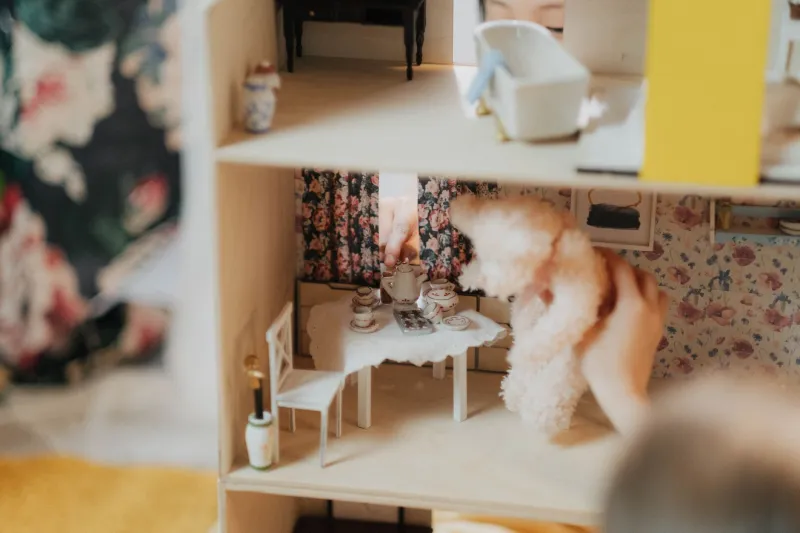
The practical range of these projects is considerable. At the modest end, a maker might install a small arched doorway, no taller than two inches, cut into the baseboard of a hallway — painted in a color that suggests age, fitted with a tiny brass knocker, and left otherwise to the imagination of whoever notices it. At the more elaborate end, a wall cavity might contain a fully appointed room: plastered walls hung with postage-stamp paintings, a working fireplace constructed from polymer clay and LED components, bookshelves stocked with hand-bound volumes whose spines carry legible titles, and a kitchen table set for a meal that will never be eaten by anyone a human being could see.
Electrical outlets become storefronts. The space beneath a staircase becomes a neighborhood. A gap in the wainscoting becomes the entrance to a subterranean library. The makers who pursue these projects at serious depth frequently speak about the experience in terms that are less about craft and more about narrative responsibility — the sense that once a world has been established, it carries its own internal logic and must be honored accordingly.
Forums and social media communities devoted to this practice have developed their own vocabulary. A hidden installation is often called a "pocket world" or, borrowing the Norton terminology directly, a "borrower build." The community exchanges advice on materials — which adhesives hold at small scale, which paints replicate aged plaster convincingly, how to route low-voltage lighting through a wall without violating building codes — but the conversations that generate the most engagement are invariably about narrative: who lives here, what is their history, what does the arrangement of their furniture reveal about their character.
The Philosophical Dimension
What is perhaps most striking about this practice is the degree to which it reframes the maker's relationship to their own home. A house, understood architecturally, is a structure designed for human habitation at human scale. Its interior dimensions, its door heights, its window placements — all of these reflect a set of assumptions about the body that will occupy the space. To introduce a hidden world calibrated to a radically different scale is to suggest, quietly and persistently, that those assumptions are not the only ones available.
Several practitioners have described a perceptual shift that occurs after completing a significant installation: a new habit of noticing the margins of rooms, the dark spaces beneath furniture, the architectural shadows that human occupation tends to ignore. The home becomes, in a meaningful sense, larger — not in its measured dimensions but in its imaginative ones. It acquires depth that floor plans cannot record.
This is, in essence, what the best miniature literature has always accomplished on the page. Swift's Lilliput and Norton's borrowed house both expand the reader's sense of what a space might contain. The American makers working inside their own walls are doing something structurally similar, except that the text is three-dimensional and the reader is also the author.
Community as Co-Author
The social dimension of this practice deserves particular attention. Many makers share their installations online not merely to demonstrate craft but to invite interpretation — to ask the community what story the tiny room tells, who its occupants might be, what has happened in the hours before the photograph was taken. The responses frequently develop into collaborative fiction, with strangers contributing character histories, neighborhood lore, and plot developments that the original maker then incorporates into subsequent installations.
This is collaborative worldbuilding of an unusual kind: distributed, asynchronous, and anchored to a physical object that most participants will never see in person. The pocket world functions as a shared text, one that accumulates meaning through the attention of its readers even as it remains physically hidden inside someone's home in Ohio or Oregon or Virginia.
The Invitation Embedded in the Walls
There is something quietly radical about the decision to build a hidden world that most visitors to one's home will never discover. It is an act of generosity directed at no particular audience — or rather, at an audience defined entirely by the quality of their attention. The child who notices the small door in the baseboard and kneels to examine it has, in that moment, become the kind of reader that literature has always hoped to produce: one willing to take seriously what the incurious would walk past without a glance.
In this respect, the American pocket-world maker is doing something that Swift and Norton would likely recognize. They are building an argument, in wood and paint and miniature furniture, for the proposition that the world is larger than it appears — that consequence is not a function of scale, that a civilization two inches tall deserves the same imaginative respect as one that fills a continent, and that the walls of an ordinary house might, if properly attended to, turn out to be inhabited after all.