Painted Legions, Unwritten Laws: How Indie Board Game Makers Are Conjuring Literary Universes One Figurine at a Time
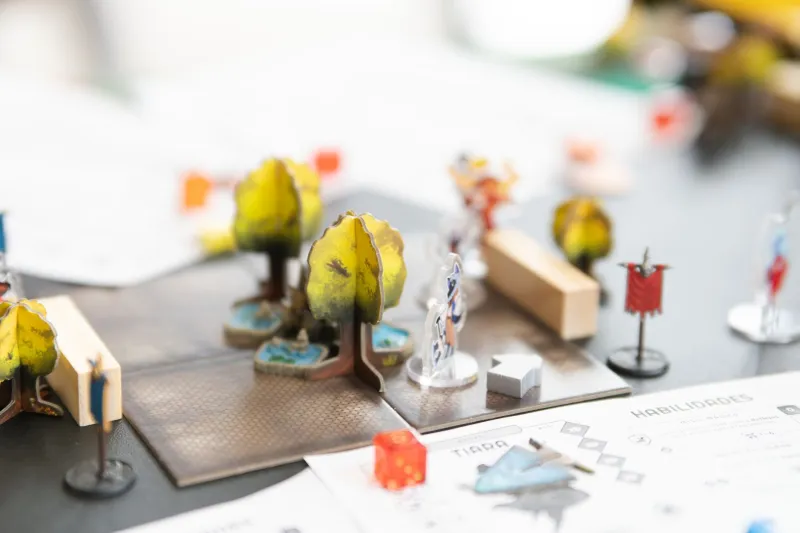
There is a peculiar satisfaction in placing a painted figure no taller than your thumbnail onto a hand-sculpted hill of foam and plaster, surveying a battlefield that exists nowhere in nature and yet feels, for one suspended moment, entirely real. This is the sensation that millions of American hobbyists have been chasing with increasing devotion, and it is the sensation that a new generation of independent board game designers has learned to engineer with the precision of novelists.
The miniature board game movement — encompassing everything from sprawling dungeon-crawlers like Gloomhaven to meticulously hand-crafted indie productions funded through Kickstarter campaigns — has grown into one of the most culturally rich corners of American creative life. It is not merely a hobby. It is, at its most ambitious, a form of world-building that rivals anything produced between the covers of a book.
The Grammar of Small Things
To understand why the miniature matters in this context, one must first appreciate what a painted figurine actually does to a player's imagination. Unlike a printed card or a wooden token, a three-dimensional figure carries weight — literal and otherwise. It implies a history. A barbarian with a chipped shield and a cloak painted in three shades of brown suggests a life lived before the game began. A crumbling tower rendered in textured resin implies a civilization that rose and fell before any player sat down at the table.
Designers working in this space speak openly about the literary ambitions embedded in their physical objects. Isaac Childres, whose Gloomhaven became one of the highest-funded board game projects in Kickstarter history, has described his design philosophy in terms that would not be out of place in a creative writing workshop: every component, he has argued, should communicate story before a single rule is read.
This is a philosophy with deep roots. Jonathan Swift understood, when he placed Lemuel Gulliver among the six-inch citizens of Lilliput, that scale is never merely a physical fact — it is a narrative argument. To make something small is to make it legible, to force the eye to slow down and attend. The indie board game movement has arrived, by a different road, at the same conclusion.
The Workshop Behind the World
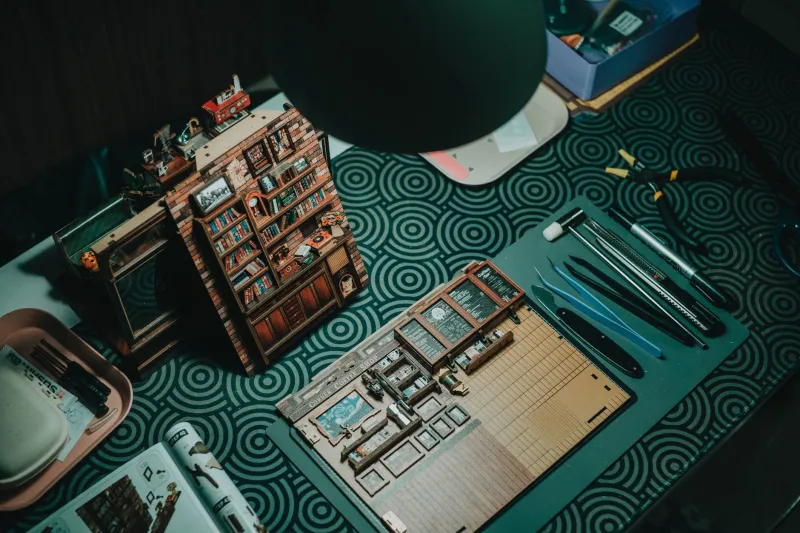
What distinguishes the current American indie scene from its commercial predecessors is the degree to which individual creators are assuming full authorial control over their miniature universes. In cities from Portland to Pittsburgh, designers are operating out of converted garages and spare bedrooms, sculpting original figures in digital modeling software, printing terrain on consumer-grade resin printers, and writing rulebooks that read more like novellas than instruction manuals.
The economics are striking. A dedicated hobbyist might spend upward of three thousand dollars assembling a single campaign's worth of painted figures and custom terrain — and consider that expenditure entirely reasonable. What they are purchasing is not entertainment in the conventional sense. They are purchasing a world, one that they will continue to expand, modify, and personalize across months or years of play.
This investment invites comparison to the collector's impulse that drives rare book enthusiasts and dollhouse miniaturists alike. In each case, the practitioner is building a relationship with a scaled-down reality that rewards patience, attention, and craft. The board game hobbyist who spends forty hours painting a single dragon is engaged in an act of creative devotion that any serious reader will recognize.
Narrative Terrain
Perhaps the most literarily significant development in recent indie design is the elevation of terrain itself to a storytelling medium. Earlier generations of tabletop games used printed maps and cardboard tiles to represent space. Contemporary designers have moved decisively toward three-dimensional environments — modular dungeon walls, sculpted forest floors, ruined city blocks assembled from interlocking resin pieces — that transform the tabletop into something closer to a theatrical set.
The implications for narrative are considerable. When players can see the shadow a tower casts across a village square, when they can position their figures in doorways and behind crumbling walls, the spatial imagination is engaged in ways that a flat map simply cannot achieve. The world becomes tactile. It becomes, in the fullest sense, inhabitable.
Designers like Nikki Valens, whose work on Mansions of Madness and Eldritch Horror has been celebrated for its atmospheric density, have spoken about terrain design in terms of emotional architecture — the deliberate arrangement of physical space to produce psychological effects in the player. This is, of course, precisely what a skilled novelist does with setting.
The Community as Co-Author
What makes the American indie board game scene particularly vital is its collaborative spirit. Online communities — on forums, Discord servers, and dedicated subreddits — function as living workshops where designers share terrain-building techniques, painting tutorials, and narrative expansions for one another's games. A designer in Austin might publish a free set of custom scenarios for a game produced by a studio in Minneapolis; a hobbyist in Ohio might sculpt and share a digital terrain file downloaded and printed by thousands of players across the country.
This collaborative authorship produces something that no single novelist can achieve: a world that grows in unpredictable directions, shaped by the collective imagination of its inhabitants. It is, in miniature, the kind of living literary culture that Swift himself might have recognized — a society of small but serious citizens, each contributing a sentence to a story none of them could have written alone.
Why Scale Still Matters
The miniature board game movement, for all its contemporary trappings, is animated by a very old desire. Human beings have always wanted worlds they could govern — spaces where the bewildering scale of actual life gives way to something comprehensible, beautiful, and entirely their own. The Thorne Rooms in Chicago express this desire. The diorama builders of the nineteenth century expressed it. Swift expressed it, with rather more satirical intent, in 1726.
What the indie board game movement adds to this tradition is a social dimension: these are worlds built to be shared, argued over, and expanded by communities of players who care, sometimes with startling intensity, about the integrity of the fictional spaces they inhabit together. That intensity is not frivolous. It is the mark of an imagination that takes its pleasures seriously — and in doing so, honors the oldest purpose of storytelling.