Picket Fences, Broken Dreams: The Artists Turning the Dollhouse Into an Instrument of American Reckoning
The Victorian dollhouse was never simply a toy. It was, from its earliest iterations, a didactic object — a model of correct domestic arrangement, a lesson in the proper disposition of furniture, servants, and aspiration. Little girls who arranged its rooms were rehearsing, in miniature, the life that awaited them. The house taught them what a house should look like, and by extension, what a life should look like.
This history is precisely why a number of American artists have chosen the dollhouse as their preferred medium for dismantling the mythology of the American Dream. To take a form so thoroughly associated with normalcy and fill it with the evidence of that normalcy's violence is an act of artistic economy that carries unusual force. The miniature domestic space, it turns out, is not merely a vehicle for nostalgia. It is a weapon.
The Uncanny at One-Twelfth Scale
The term most frequently invoked in discussions of subversive miniature art is the uncanny — Freud's formulation of the unease produced when something familiar is rendered strange. No object is better suited to produce this effect than the dollhouse, which is by definition a copy of something we know intimately. When artists introduce into that familiar space elements that violate its conventions — a kitchen wallpapered with pharmaceutical advertisements, a living room whose bookshelves hold only self-help titles, a nursery in which every surface is branded — the dissonance is immediate and visceral.
Laurie Simmons, whose photographic work with dollhouse interiors across several decades has influenced an entire generation of artists, understood this dynamic early. Her images of miniature domestic scenes — empty rooms, isolated figures, spaces that suggest narrative without completing it — exploit the dollhouse's inherent ambiguity. The miniature room implies a life. When that life is withheld or distorted, the viewer's imagination rushes into the gap, and what it finds there is rarely comfortable.
Suburban Mythology Under Glass
Among the most compelling practitioners working today is a cohort of artists who focus specifically on the postwar American suburb as their subject. The suburban ranch house — with its attached garage, its manicured lawn, its studied informality — is, in miniature form, immediately recognizable to any American viewer. It is also, these artists argue, a space saturated with ideological content that has never been adequately examined.
Sarah Conner Lucas, a Chicago-based installation artist whose work has appeared in group exhibitions at the Museum of Contemporary Art, constructs suburban dollhouses in which every room contains evidence of the labor required to maintain the illusion of effortlessness. Tiny laundry rooms overflow with unsorted clothes. Kitchen counters are crowded with meal-prep detritus. The television in the living room displays, at one-twelfth scale, a real estate program. The effect is not satirical in any broad sense — it is documentary, and the more devastating for it.
"I want people to look at these rooms and feel recognition before they feel critique," Lucas has said in statements accompanying her installations. "The critique only works if you've already said yes to the thing being critiqued."
This is a principle that Swift would have appreciated. The first three books of Gulliver's Travels succeed as satire precisely because they begin with the pleasures of adventure and discovery. The reader is inside the world before the argument begins.
The Politics of Proportion
Other artists have pushed the critical project in more explicitly political directions. In recent years, gallery installations in New York, Los Angeles, and Washington, D.C., have featured dollhouses constructed as direct commentaries on housing inequality, consumer debt, and the racial geography of American neighborhoods.
One particularly striking example, exhibited at a Brooklyn gallery in 2022, presented a row of identical suburban houses in which the interiors diverged dramatically based on the implied race and class of the occupants — a visualization, in miniature, of the discriminatory lending practices and restrictive covenants that shaped the postwar American landscape. The houses were beautiful objects. They were also, their creator argued, crime scenes.
This strategy — using the aesthetic pleasures of miniature craft to draw viewers into a critical encounter they might otherwise resist — is one that feminist artists have employed for decades. The Guerrilla Girls famously noted that the art world was more comfortable with female nudity than female authorship; the artists working in subversive miniature have noted, with similar precision, that the art world is more comfortable with the dollhouse as decoration than as argument.
Craft as Critical Language
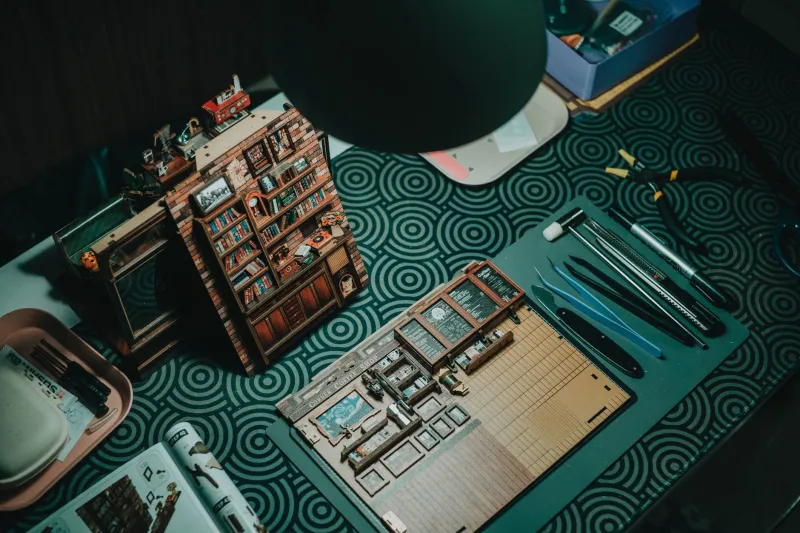
What unites the artists working in this tradition is a commitment to craft that is itself a form of argument. These are not rough or gestural works. They are objects of extraordinary technical refinement — rooms in which wallpaper patterns are hand-applied with tweezers, in which furniture is constructed from actual hardwoods, in which the tiny books on the shelves have legible spines. The labor is inseparable from the meaning.
This insistence on craft carries a specific rhetorical force. It refuses the viewer the comfortable dismissal of outsider art or amateur production. These are works made by people who have mastered the conventions of their medium — and who have then chosen to violate those conventions with full knowledge of what they are doing. The precision of the execution makes the subversion impossible to ignore.
It also, perhaps unexpectedly, places these artists in dialogue with the great tradition of American miniaturists — the Thorne Room makers, the dollhouse collectors, the diorama builders whose devotion to scale and detail has always carried an element of obsessive love. The subversive dollhouse artist is not rejecting that tradition. She is, in the most literal sense, inhabiting it — and rearranging the furniture.
Tiny Rooms, Large Arguments
The American dollhouse, in its subverted form, has become something that its Victorian inventors could never have anticipated: a space of genuine intellectual risk. The artists who work in this medium are not making comfortable objects. They are making arguments — about gender, about race, about the seductions and violences of consumer culture — in a form that disarms the viewer before the argument is made.
That disarmament is the point. The miniature has always had the power to make us lower our defenses, to invite a kind of attention that larger-scale work cannot always command. The artists who have seized this power and turned it toward critique are doing something that belongs, in its deepest logic, to the tradition of Swift himself: using the pleasures of the small to say things that the large world would prefer not to hear.