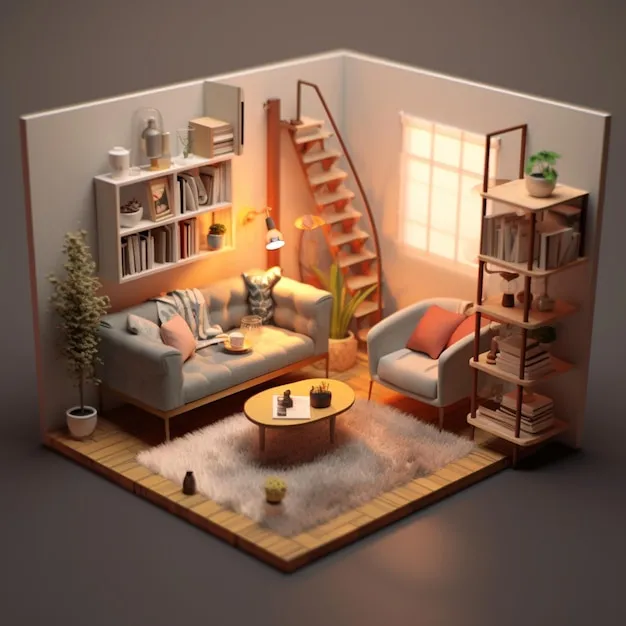
After Lilliput: How Miniature Builders Come to See the Full-Sized World Differently
Photo: Unknown authorUnknown author or not provided, Public domain, via Wikimedia Commons
There is a particular kind of embarrassment that veteran miniaturists describe when they first try to explain it to someone who does not build. They will be walking down an ordinary city street, or sitting in a diner, or standing in a hardware store, and they will stop—sometimes mid-sentence—to stare at something no one else has noticed. A corbel on a nineteenth-century storefront. The precise way afternoon light pools in the corner of a tiled floor. The grain of a wooden door that has not been painted in thirty years.
"My husband thought I was losing my mind," says Renata Osei, a retired schoolteacher from Columbus, Ohio, who has been building miniature domestic interiors for eleven years. "I kept stopping on walks to photograph the underside of staircases. I couldn't stop noticing how shadows fell inside window frames. Once you've spent six hours trying to replicate that in a space the size of a shoebox, you never look at the real thing the same way again."
This is what longtime practitioners call, with varying degrees of affection, the miniature museum effect—the cognitive residue left behind when the brain has been trained to attend to a world at extraordinary resolution.
A Different Kind of Looking
Miniature construction is, at its foundation, an exercise in sustained, granular attention. To build a convincing room at one-twelfth scale—the most common ratio in the American miniaturist tradition—a builder must observe the full-sized world with a rigor that borders on obsession. How thick is a real baseboard? What is the actual diameter of a door hinge? How does plaster crack? What color is shadow on a white wall?
These are not questions most people ask. But once they become habitual, they are nearly impossible to stop asking.
Dr. Priya Mehta, a cognitive neuroscientist at the University of Michigan who studies attentional systems, explains that this kind of focused, detail-oriented craft work activates and gradually strengthens the brain's capacity for what she calls "granular scene parsing"—the ability to decompose a visual environment into its constituent elements rather than processing it as a unified whole.
"The brain is fundamentally lazy about perception," Dr. Mehta notes. "It builds approximations. It takes shortcuts. What sustained miniature work appears to do, over time, is interrupt those shortcuts. Practitioners begin to see environments as collections of specific, differentiated objects rather than as background. The world becomes, in a sense, more legible."
This legibility, once acquired, does not confine itself to the workbench.
The Neglected and the Noticed
Ask any long-time miniaturist what changed first, and the answer is almost always the same: they began to find beauty in places they had previously walked past without a second glance.
Marcos Delgado, a graphic designer in San Antonio who builds Depression-era American interiors, describes driving through older neighborhoods now with what he calls "builder's eyes." "I see how a porch sags on one side. I notice where someone patched a wall with a slightly different brick. I see all the small evidence of time and repair that used to be invisible to me. It's like the miniatures gave me a new frequency to tune into."
This sensitivity extends, for many builders, to a changed relationship with consumption and material goods. The labor involved in replicating a single antique chair at one-twelfth scale—hand-carving the legs, stretching fabric across a frame the size of a thumbnail—tends to instill a deep appreciation for the craftsmanship embedded in ordinary objects.
"I cannot walk through a furniture store the same way," says Osei. "I know what it takes to make a joint. I know what real wood feels like versus veneer. I've become a very inconvenient person to shop with."
Clutter and Consequence
There is a related and perhaps counterintuitive effect that many miniaturists report: a dramatic reduction in their tolerance for clutter and excess. This seems, at first glance, paradoxical. These are people who collect tiny objects, who fill cabinets with miniature crockery and diminutive paintings no larger than a postage stamp. And yet the discipline of curating a miniature space—where every object must earn its presence because the space cannot absorb the superfluous—appears to migrate into the builder's broader domestic life.
"Every object in a miniature room is a decision," says Claire Fontaine, a librarian in Portland, Oregon, who builds miniature libraries. "Nothing is there by accident. Nothing is there because you forgot to move it. That discipline changes how you think about your actual home. I got rid of half my possessions in the year after I started building seriously. Not because I was minimizing for its own sake, but because I had trained myself to ask: does this object deserve to be here?"
Dr. Mehta finds this plausible. "When you develop a heightened sensitivity to the visual and material composition of space, you become more aware of dissonance—of objects that don't belong, of chaos that previously registered only as ambient noise. The trained eye is a more demanding eye."
The Lilliputian Inheritance
Swift's Gulliver, arriving in Lilliput, found that smallness forced a kind of reckoning. The miniature world did not diminish meaning; it concentrated it. The same logic operates here. To build small is to be compelled to think carefully about what deserves to exist at all—what architectural detail is worth preserving, what object merits space, what story is worth telling with such painstaking precision.
The builders who have passed through that discipline and emerged from it carry something that is difficult to name but easy to recognize. They walk differently through the world. They pause where others rush. They notice the corbel, the grain, the shadow in the corner of the tiled floor.
The world has not grown smaller for them. It has grown, in every meaningful sense, larger.
And perhaps that is the most Lilliputian lesson of all: that the act of attending to the miniature is, in the end, an act of expanding one's capacity to perceive the immense.