The Three-Dimensional Sentence: Miniature World-Building as a Legitimate Literary Form
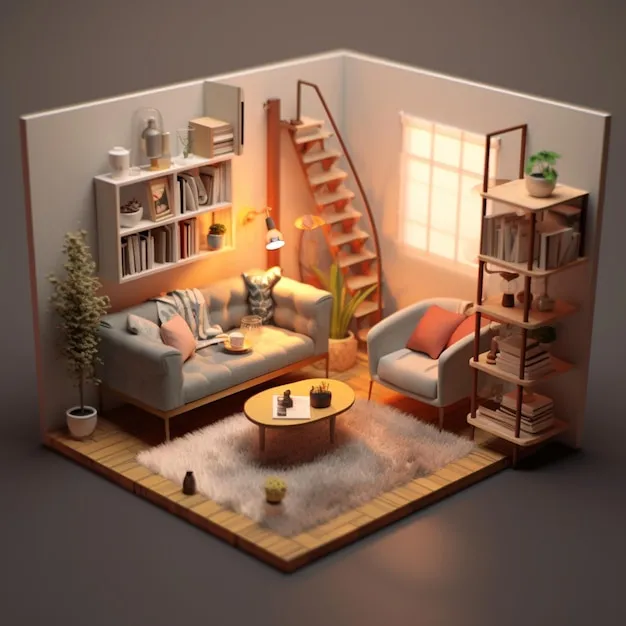
Photo: detailed miniature room scene with tiny furniture and objects viewed from multiple angles, via img.freepik.com
Consider what a novel cannot do. It cannot be approached from the left side. It cannot be crouched beside, peered into from below, or examined from an angle the author did not anticipate. Its perspective is fixed—or rather, the range of available perspectives is fixed. The reader moves through the text in a direction the author has determined, encountering revelations in the sequence the author has arranged. This is not a limitation to be overcome; it is the nature of the form. But it is a constraint, and constraints define what a medium can and cannot say.
The miniature constructed world operates under a different set of constraints entirely. It is spatial rather than sequential. It can be approached from any direction. It holds its narrative not in the unfolding of a timeline but in the simultaneous arrangement of objects, textures, light, and space. The story does not move—the audience does.
This distinction is not merely aesthetic. It is, a growing number of artists and critics argue, the foundation of an entirely distinct literary form.
What Flat Media Cannot Hold
The critical establishment in the United States has long maintained a hierarchy of narrative forms, with the novel at its apex and visual and tactile media arranged in rough descending order below it. Comics earned their seat at the table slowly and contentiously. Film had to fight for decades before it was discussed in universities alongside Shakespeare. The graphic novel remains, in certain academic quarters, a grudging admission rather than a genuine welcome.
Miniature world-building has not yet made that argument for itself in any sustained or systematic way. But the artists working in the form are beginning to do so, and the work they are producing demands a serious response.
Take the case of Simone Achebe, a Brooklyn-based artist whose series of constructed miniature environments—collectively titled What Remains—has toured three American museums since 2021. Each piece in the series depicts a room from a different stage of a single fictional family's history: a Harlem parlor in 1943, a suburban kitchen in 1978, a college dormitory in 2003. No text accompanies the works. No explanatory labels describe the narrative arc. The story is held entirely in the objects, the wear patterns on the furniture, the photographs pinned to walls, the food left half-eaten on a table.
"I wanted to make something you couldn't read in order," Achebe has said. "A novel tells you when to feel something. I wanted the viewer to discover feeling at their own pace, from their own direction. Someone who crouches down and looks through the parlor window from outside gets a completely different story than someone who looks in from above."
This is a narrative proposition that no flat medium can replicate. The graphic novelist can vary panel size and angle. The filmmaker can cut. But neither can offer the reader or viewer genuine physical agency over perspective. The miniature world can.
Constraints as Generative Force
Every literary form is shaped by what it cannot do as much as by what it can. The sonnet's fourteen lines are not a prison; they are the pressure that makes the poem possible. The short story's compression is not a failure of the novel's expansiveness; it is a different kind of truth-telling.
The constraints of the miniature form are equally generative. Scale is the most obvious: at one-twelfth or one-sixth size, a builder cannot include everything. Every object that occupies space in the world must be earned. This enforced economy of detail is not unlike the economy demanded of the poet—and the result, in skilled hands, is a similar kind of density. Each chosen object carries more weight because it has been chosen.
Dr. Laurence Whitfield, who teaches narrative theory at Georgetown University and has written about spatial storytelling, draws a comparison to the Japanese art of ma—the meaningful use of negative space. "What is absent from a miniature world is as narratively significant as what is present," he observes. "A skilled miniature storyteller uses the empty chair, the bare wall, the unworn coat on the hook to tell you something no sentence could say without explaining itself to death."
The physical materiality of the form introduces another constraint that flat media cannot replicate: the irreversibility of texture and aging. A miniature builder working with real wood, real fabric, real paint cannot undo the way those materials will change over time. The cracking of aged glue, the fading of dyed fabric, the warping of thin wood—these become part of the narrative in ways the builder did not script. The story, in a sense, continues to be written after the builder has set down their tools.
Identity, Loss, and the Object That Speaks
The most compelling miniature narratives being made in America today share a preoccupation with the themes that have always animated serious literature: identity, loss, and the question of where we belong.
Jordan Sato, a Japanese American artist working in Oakland, builds miniature interiors of Japanese American homes from before and after the internment period of World War II. The before-and-after structure is not labeled; it is embedded in the objects themselves—the presence or absence of certain items, the state of repair or disrepair, the things that were kept and the things that were not.
"I am not illustrating history," Sato has said. "I am making a space where history can be felt rather than read. There's a difference between knowing that families lost everything and standing in front of a room where you can see the outline on the wall where a picture used to hang."
This is what the miniature form offers that the novel, for all its power, cannot: the outline on the wall. The physical, three-dimensional evidence of absence. The invitation not merely to imagine a space but to inhabit it, however briefly, from outside.
A Form in Search of Its Critics
For miniature world-building to take its place alongside the novel and the film as a recognized literary form, it will need more than gifted practitioners. It will need critics willing to develop a vocabulary adequate to what the form actually does—spatial rather than sequential, tactile rather than textual, simultaneous rather than linear.
The tradition of Gulliver's Travels offers, perhaps unexpectedly, a useful starting point. Swift understood that miniaturization was not diminishment. It was a means of defamiliarization—of making the familiar strange enough to be seen clearly. The miniature world does not shrink its subject. It concentrates it.
That concentration is the form's central literary act. And it deserves to be read as such.