Bound in Miniature: The American Collectors Who Devote Their Lives to Libraries You Could Lose in a Coat Pocket

There is a particular kind of reverence that overtakes a person the first time they hold a fully realized book in the palm of one hand and realize it is smaller than their thumbnail. The spine is stitched. The pages turn. The text, rendered in type so fine it approaches the edge of human perception, is entirely legible — if one possesses the patience, and the correct magnification. For a growing number of American collectors, this moment of revelation is not an oddity encountered once at a curiosity shop. It is the organizing principle of an entire collecting life.
Miniature books — formally defined by the Miniature Book Society as volumes no taller than three inches — occupy a peculiar and largely uncharted territory between the literary and the artisanal. They are books in every meaningful sense: authored, printed or hand-lettered, bound, and meant to be read. Yet they exist at a scale that transforms the act of reading into something closer to archaeology, requiring tools, patience, and a willingness to slow down in ways that our ordinary relationship with text rarely demands.
A Tradition Older Than the Republic
The miniature book is not a modern affectation. Tiny volumes have been produced since at least the fifteenth century, when European printers recognized that a pocket-sized psalter or almanac carried genuine practical value for travelers and clergy alike. By the seventeenth century, miniature books had become objects of courtly prestige — gifts exchanged between monarchs, tucked into the jeweled cabinets of queens. The tradition arrived in America with the early printing trade, and by the nineteenth century, publishers in Boston and New York were producing miniature editions of the Bible, Shakespeare, and popular poetry as novelties for a literate middle class with an appetite for the remarkable.
What distinguishes today's American collectors from their predecessors is the degree to which the miniature book has shed its purely functional ambitions. The volumes being acquired and, in many cases, commissioned today are works of sustained artistic intention — objects in which the constraint of scale is not a limitation but the entire point.
The Libraries Behind Closed Doors
The Miniature Book Society, founded in 1983 and headquartered in the United States, remains the primary organizing body for serious collectors across the country. Its annual gatherings draw dealers, artists, librarians, and enthusiasts from across North America, and its membership roster reads like a census of quiet obsession. Members speak of their collections in the language of curatorship: provenance, condition, rarity, edition. A single volume by a celebrated miniature press — the Gleniffer Press of Scotland, say, or the celebrated work of American miniaturist Arthur Neergaard — can command prices that would surprise anyone who imagines tiny books as mere trinkets.
Several institutional collections in the United States have begun to take the form seriously. The Library of Congress holds a notable miniature book collection, and the Lilly Library at Indiana University preserves examples dating back centuries. Yet the most extraordinary libraries often exist behind private doors: rooms in suburban homes where custom-built shelving displays hundreds of volumes in illuminated cases, each book catalogued with the same care a rare manuscript librarian might bring to a medieval folio.
One collector based in the Pacific Northwest — who asked to be identified only by her collecting alias, a practice not uncommon in this community — described the moment she understood the depth of her commitment. She had acquired a hand-lettered edition of Emily Dickinson's selected poems, produced by a California artist over the course of four months. The book measured one and a half inches tall. Every line of verse was present. Every stanza break was honored. 'I realized,' she said, 'that the person who made this had thought more carefully about those poems than almost any reader ever would. The scale forced a kind of attention that changes what the work means.'
What Draws the Bibliophile to the Infinitesimal
That observation — that miniaturization produces a heightened form of attention — recurs throughout conversations with collectors and artists in this field. There is something almost meditative about the encounter with a tiny book, a quality that stands in sharp contrast to the accelerated, scrolling pace at which most Americans now consume written language. To read a miniature volume is to accept, in advance, that the experience will be slow. The magnifying glass must be found. The light must be arranged. The pages, impossibly delicate, must be turned with a degree of care that ordinary books never require.
In this sense, the miniature book functions as a kind of literary counterargument — a physical insistence that the written word is worth this level of effort, this degree of ceremony. Collectors frequently describe their tiny volumes not as substitutes for full-sized reading but as companions to it: objects that remind them, by their very impracticality, of why they loved books in the first place.
This resonates with a broader cultural current in American bibliophilia. At a moment when e-readers and digital libraries have made the physical book increasingly optional, the miniature book asserts the materiality of the reading object with unusual force. It is impossible to forget, when holding a book the size of a sugar cube, that what you are holding is a made thing — the product of human hands, human decisions, human devotion.
The Artists Who Make the Impossible Legible
Behind every collected miniature book is an artist who chose to work at this scale deliberately. The craft demands printmaking skill, bookbinding expertise, and, in many cases, a willingness to hand-letter text at dimensions that test the limits of fine motor control. Several American artists have built substantial reputations in this field, their work sought by institutional and private collectors alike.
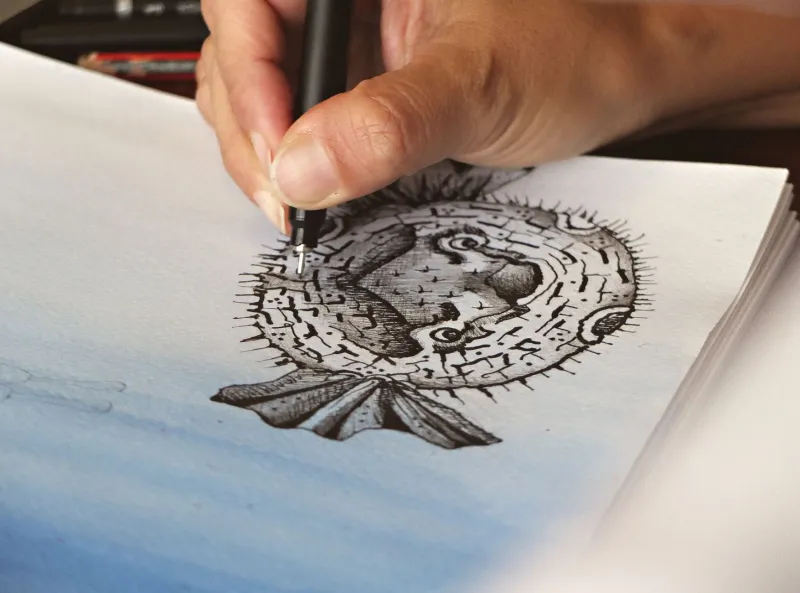
The process of producing a miniature book varies by artist and method. Some use photographic reduction to render existing typeset text at microscopic scale before printing on tissue-thin paper. Others letter by hand, using tools modified to produce strokes measured in fractions of a millimeter. Bindings — the stitched spines, the cloth or leather covers, the sometimes gilded page edges — are executed with instruments borrowed from watchmaking and jewelry. A single edition of twenty-five copies might represent months of labor.
For these artists, the miniature book is not a diminishment of literature but a distillation of it. Every element that makes a book a book — the cover, the binding, the title page, the colophon — must be present and must function. Nothing can be abbreviated on the grounds that it is too small to matter. In this respect, the miniature book operates as a kind of proof: evidence that the architecture of the book is essential rather than incidental, that what surrounds the text is part of what makes the text meaningful.
A Community Built on Shared Wonder
What unites the collectors, artists, librarians, and dealers who inhabit this world is not, ultimately, a shared investment in smallness for its own sake. It is a shared conviction that the book — as object, as artifact, as vessel for language — is worthy of the most exacting attention human hands can bring to it. The miniature book does not ask to be read quickly or casually. It asks to be held, examined, and appreciated with something approaching awe.
In a culture that frequently treats books as content rather than objects, this is a quietly radical proposition. The collectors preserving these tiny libraries are not eccentrics indulging a harmless fancy. They are, in their own precise and patient way, making an argument about what literature is worth — and insisting, volume by improbable volume, that the answer is: everything.