Pixels and Particulars: How a New Generation Is Learning to Build Worlds From the Screen Outward
For most of recorded history, the art of miniature world-building was inseparable from the art of miniature making. To construct a convincing one-twelfth-scale library required not only imagination but a mastery of materials: the patience to hand-turn a spindle no wider than a matchstick, the precision to cut book spines from leather scraps, the dexterity to wire a chandelier from copper thread and glass beads. These were skills accumulated across years of apprenticeship, sustained by communities of practice, and transmitted through direct, embodied instruction.
The digital tools now available to teenagers in American bedrooms have not abolished that tradition. But they have placed beside it an entirely new pathway—one that begins with a cursor rather than a chisel, and that opens the door to miniature world-building for an audience that would never have found the threshold before.
The New Toolkit
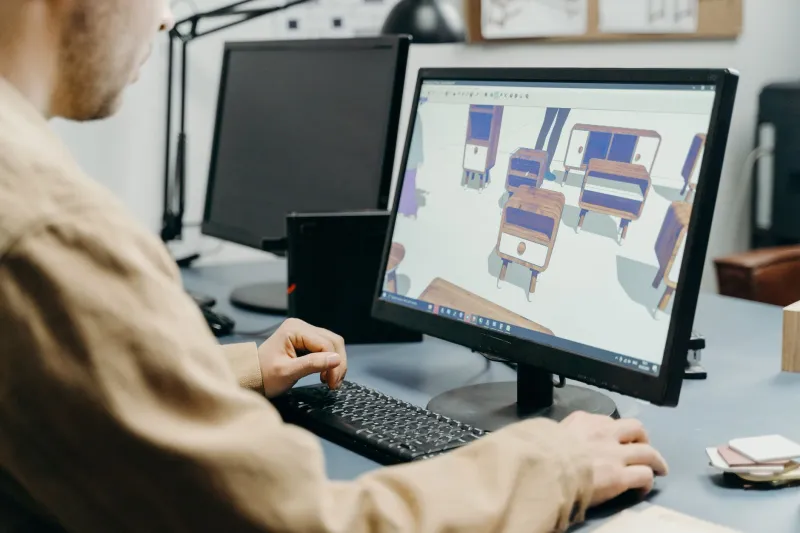
The landscape of accessible digital design has changed with remarkable speed. Software platforms such as Blender, Tinkercad, and SketchUp—once the exclusive province of professional designers and architectural firms—are now freely available and actively taught in middle and high school technology curricula across the United States. AI-assisted design tools have further compressed the learning curve, allowing users with no formal training to generate detailed three-dimensional environments from text prompts and iterative refinement.
Virtual reality adds another dimension entirely. Platforms such as Rec Room and VRChat host communities of builders who construct and inhabit miniature environments with a level of immersive detail that no physical diorama can replicate: rooms that can be entered and explored, lighting conditions that shift with the time of day, atmospheric effects that respond to narrative context. For a generation that has grown up inside the constructed worlds of Minecraft and Animal Crossing, the conceptual leap to intentional miniature world-building is a short one.
For readers seeking a literary framework through which to understand this phenomenon, the following works offer useful illumination:
On the psychology of constructed worlds: Ursula K. Le Guin's essay collection The Language of the Night remains an essential meditation on the imaginative act of world-building and the responsibilities it confers upon its practitioners. Le Guin's arguments about secondary creation translate with surprising directness to the digital context.
On craft and constraint: Matthew Crawford's The World Beyond Your Head provides a rigorous philosophical account of why skilled making with physical materials produces a distinctive form of attention and knowledge—and what may be at stake when that mode of engagement is bypassed.
On digital creativity: Clive Thompson's Coders: The Making of a New Tribe and the Remaking of the World offers an accessible account of the cultural values embedded in software communities, many of which overlap meaningfully with the collaborative ethos of traditional miniature crafting.
On the history of miniature making: Tania Kovats's The Drawing Book and the exhibition catalog for the Art Institute of Chicago's Thorne Miniature Rooms collection together provide indispensable context for understanding the long tradition into which digital practitioners are—consciously or not—inserting themselves.
The Gateway Question
The most consequential debate within the miniature crafting community concerns precisely this relationship between digital and analog practice. Veteran artisans who have spent decades mastering the physical disciplines of the craft tend to view digital tools with a mixture of admiration and wariness. The admiration is genuine: they recognize that three-dimensional modeling software can solve design problems that would take weeks to work out by hand, and that digital fabrication technologies such as resin printing have made it possible to produce components of astonishing precision at accessible price points.
The wariness is equally genuine. There is, these practitioners argue, something irreplaceable in the knowledge that accumulates through direct material engagement—the understanding of how wood grain responds to a particular blade, how paint behaves on a porous versus a sealed surface, how the weight and texture of fabric at one-twelfth scale must be selected to fall convincingly rather than stiffen into implausibility. This knowledge cannot be abstracted into a software parameter. It must be earned through repetition and failure and the patient education of the hands.
The question of whether digital tools constitute a gateway back to that kind of knowledge—or a comfortable alternative that forecloses it—does not yet have a settled answer. Early evidence is genuinely mixed. Some young digital builders, having achieved satisfying results on screen, find themselves curious about physical realization and begin experimenting with materials. Others remain contentedly within the digital environment, discovering in it a sufficient and self-contained creative world.
Swift's Lesson for the Screen Age
Jonathan Swift, composing Gulliver's Travels in the early eighteenth century, was among the first writers to understand that the miniature world functions as a mirror—that examining something very small, very closely, reveals truths about the large world that direct observation obscures. The Lilliputians were not simply comic figures of diminishment. They were a civilization whose contradictions and vanities became visible precisely because they could be seen whole.
Digital miniature world-building offers something analogous. The teenager who spends an afternoon arranging the furniture of a virtual one-room apartment, calibrating the angle of afternoon light through a simulated window, is engaged in an act of attention that is not categorically different from what the traditional artisan performs with glue and balsa wood. Both are asking: what does a space need in order to feel inhabited? What is the minimum necessary to produce the sensation of a life lived here?
These are, ultimately, literary questions as much as craft questions. They are the questions that Gulliver's tiny hosts asked of him, and that he, in his enormity, was too distracted to ask of himself.
A Reading List for the Digital Miniaturist
For those wishing to explore the intersection of digital creativity, miniature craft, and imaginative world-building more deeply, the following resources are recommended:
- Stewart Brand, How Buildings Learn — a foundational text on how designed spaces accumulate meaning over time, applicable to both physical and virtual environments.
- Gaston Bachelard, The Poetics of Space — the philosophical work most frequently cited by serious miniaturists, digital and analog alike.
- Frank Chimero, The Shape of Design — a contemporary meditation on craft, digital tools, and the ethics of making.
- Jorge Luis Borges, Labyrinths — the essential literary companion for anyone building worlds within worlds, at any scale and by any means.
The cursor and the chisel are not, in the end, opposites. They are instruments of the same ancient impulse: to make a world small enough to hold, and detailed enough to believe in.