Ruins at Roadside: Chasing the Ghost Parks of Rural America Before the Weeds Claim Them Entirely
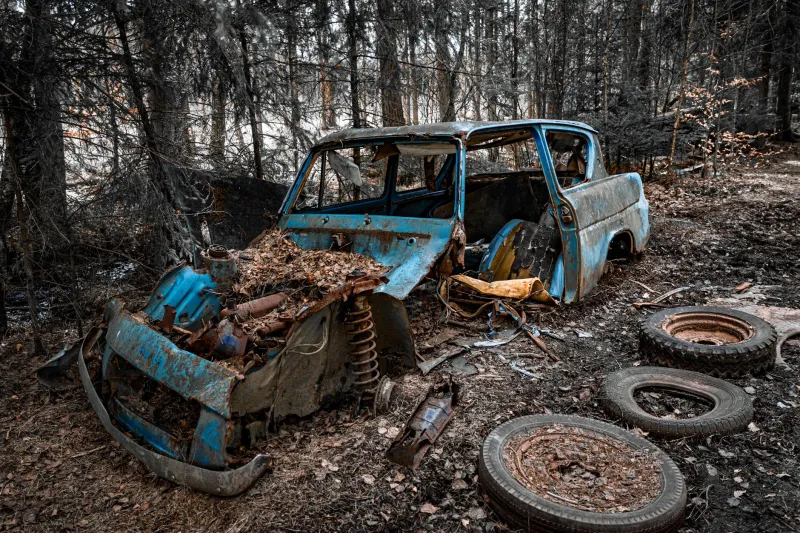
The golden age of the American roadside miniature park lasted, roughly, from the late 1940s through the early 1970s. In that interval, dozens of attractions opened across the country — in the hill country of Virginia, along the old tourist corridors of the Midwest, in the mountain passes of the Carolinas — offering travelers something that the interstate highway system would eventually make obsolete: a reason to stop.
These parks took many forms. Some were collections of miniature world monuments — the Eiffel Tower, the Leaning Tower of Pisa, the Colosseum — rendered at a scale that allowed a family to walk among them in an afternoon. Others were diorama villages, elaborate reconstructions of historical American settlements or fantastical fairy-tale landscapes populated by concrete gnomes and plaster animals. A few were genuinely ambitious productions, employing sculptors and engineers to create mechanical figures, running water features, and illuminated nighttime displays.
Most of them are gone. And the ones that remain are going.
The Literature of Vanishing Places
For readers drawn to the intersection of American history, travel writing, and the literature of loss, the story of these miniature parks offers an unusually rich vein of material. The books and essays that have accumulated around the subject of roadside Americana — from John Steinbeck's Travels with Charley to John Margolies's photographic surveys of vernacular architecture — form a canon of attentiveness to the things that America builds and then abandons.
Margolies, whose decades of documentary photography produced some of the most important records of mid-century American commercial architecture, understood that the roadside attraction was not merely kitsch. It was evidence — of aspiration, of entrepreneurial imagination, of the particular American conviction that wonder could be manufactured and sold by the acre. His photographs of miniature parks, collected in several volumes now out of print and eagerly sought by collectors, are among the most poignant documents of a vanished America that we possess.
For those wishing to enter this literature, the following titles offer an essential foundation:
- John Margolies, Miniature Golf (1987) — A photographic survey that captures the aesthetic exuberance of scaled-down American commercial entertainment at its mid-century peak.
- J.B. Jackson, Discovering the Vernacular Landscape (1984) — A collection of essays by the great American landscape critic that provides the intellectual framework for understanding why ordinary Americans build extraordinary things in unexpected places.
- Karal Ann Marling, As Seen on TV: The Visual Culture of Everyday Life in the 1950s (1994) — An essential account of the visual imagination that produced both the roadside miniature park and the suburban dollhouse in the same cultural moment.
- John Beardsley, Gardens of Revelation: Environments by Visionary Artists (1995) — Examines the folk-art tradition of large-scale environmental construction that overlaps significantly with the history of miniature parks.
- Alastair Gordon, Naked Airport: A Cultural History of the World's Most Revolutionary Structure (2004) — While not focused on miniature parks specifically, Gordon's methodology for reading vernacular American architecture is directly applicable to the subject.
The Photographers Racing the Clock
In the absence of institutional preservation efforts, the primary documentation of surviving miniature parks has fallen to a loose network of photographers, bloggers, and amateur historians who operate under the broad umbrella of what they call "ruin photography" or "roadside archaeology." Their work circulates through dedicated websites, Instagram accounts, and occasional self-published volumes that have become, in their own right, significant contributions to the literature of American vernacular culture.
What drives these practitioners is something that readers of elegiac travel writing will recognize immediately: the conviction that the act of witnessing is itself a form of preservation. To photograph a crumbling concrete gnome before the bulldozer arrives is not to save it — but it is to insist that it existed, that it mattered, that someone stood before it and paid attention. This is the impulse that animates the best American nature writing, the best urban exploration memoir, and the best documentary photography. It is also, in its way, the impulse that animates the miniature world itself: the desire to hold something still, to arrest time within a bounded space.
What the Small Parks Knew
There is a passage in Swift's Gulliver's Travels — in the third voyage, when Gulliver visits the island of Luggnagg and encounters the immortal Struldbruggs — that has always seemed to me to bear on the fate of American miniature parks. The Struldbruggs are immortal, but they are not ageless; they continue to decay while being denied the release of death. Swift's point is about the cruelty of immortality without vitality. But it is also, obliquely, about the cruelty of things that persist past their moment — that remain visible as ruins of what they were, unable to be fully present and unable to fully disappear.
The surviving miniature parks of rural America are, in this sense, Struldbruggian objects. They are too deteriorated to function as the attractions they once were, and too substantial to simply vanish. They persist in a condition of partial ruin that is, for those sensitive to such things, extraordinarily moving.
The photographers and writers who document them are not, primarily, motivated by nostalgia — or not by nostalgia alone. They are motivated by a recognition that these parks represent a specific and unrepeatable moment in American cultural history: the moment when ordinary Americans, with limited resources and extravagant imagination, decided to build worlds in miniature and invite strangers to walk through them.
A Reading Path Into the Ruins
For readers who wish to pursue this subject further, the following works — beyond those listed above — offer valuable entry points:
- Rolf Potts, Marco Polo Didn't Go There (2008) — Essays on travel and the construction of authentic experience that illuminate why roadside attractions matter to American travel culture.
- Geoff Nicholson, The Lost Art of Walking (2008) — A meditation on ambulatory attention that speaks directly to the practice of roadside archaeology.
- Rebecca Solnit, A Field Guide to Getting Lost (2005) — Solnit's essays on loss, memory, and the American landscape provide the most eloquent philosophical framework available for understanding the appeal of vanishing places.
- Stewart O'Nan, The Circus Fire (2000) — A model of documentary narrative about a forgotten American disaster that demonstrates how the recovery of lost events can restore dignity to the forgotten.
The Argument for Attention
The community of people documenting America's ghost parks is small, self-organized, and operating largely without institutional support. What they are doing is, in the deepest sense, a literary act: they are composing a record of things that would otherwise be lost, in the conviction that those things deserve to be remembered.
This is the conviction that underlies all serious engagement with miniature worlds — the belief that scale does not determine significance, that the small and the overlooked carry their own freight of meaning, and that the act of attending to them is never wasted. The crumbling Eiffel Tower in the Virginia weeds was built by someone who believed, for a season at least, that wonder was worth constructing. The least we can do is look.